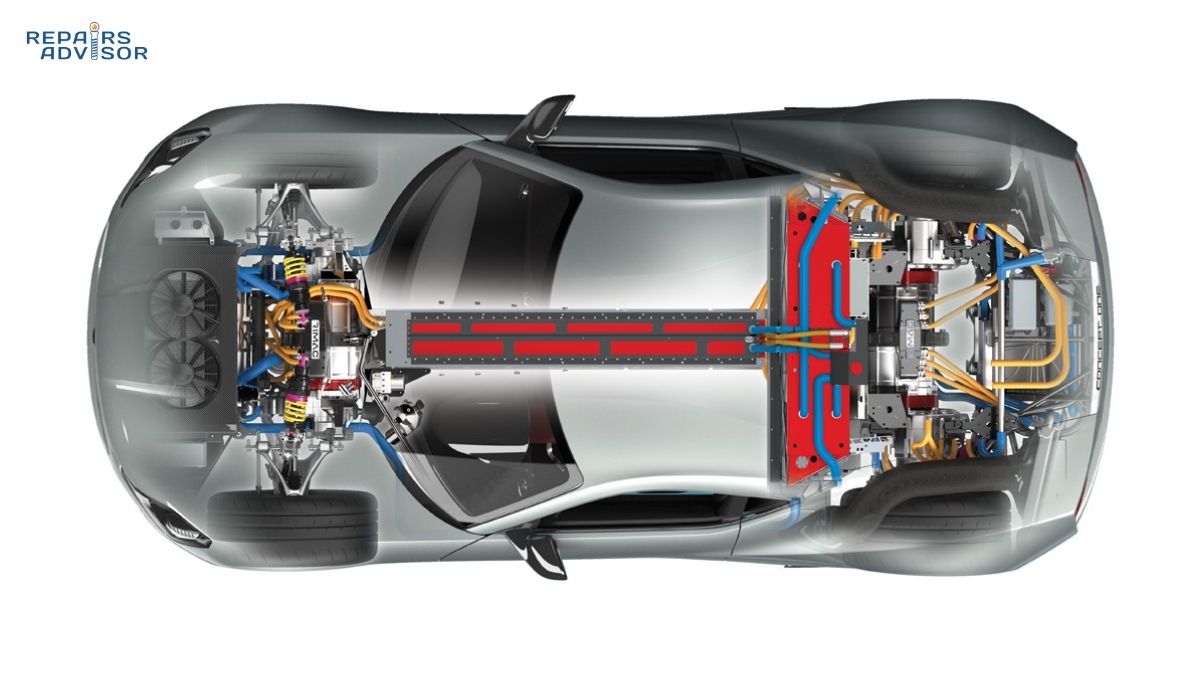
Every time you switch on the headlights, boot up the infotainment screen, or let the heated seats warm up in a hybrid or EV, a small but critical component is doing invisible work. The DC-DC converter bridges two fundamentally incompatible electrical worlds inside modern electrified vehicles — the high-voltage traction battery system and the low-voltage accessories network that every car has relied on for decades. Most drivers never think about it until it fails — and when it does, a cascade of seemingly unrelated electrical faults and a dead 12V battery can stump technicians more familiar with conventional vehicles.
Quick Answer
A DC-DC converter in a hybrid or electric vehicle steps down high-voltage DC power from the traction battery (typically 200–800V) to 12V or 48V for all auxiliary systems — headlights, ECUs, infotainment, climate control fans, and charging the 12V auxiliary battery. It replaces the belt-driven alternator found in conventional vehicles and runs continuously whenever the vehicle is in READY mode. When it fails, the 12V battery drains rapidly and the vehicle behaves exactly like one with a dead alternator — running briefly on battery reserve before stalling and refusing to restart.
What Is a DC-DC Converter? The Alternator Replacement Explained
To understand what a DC-DC converter does, it helps to start with what it replaces. In a conventional petrol or diesel vehicle, a belt-driven alternator converts mechanical energy from the running engine into electrical energy for the 12V system. That 12V system powers everything except the starter motor during cranking — lights, audio, ECUs, wipers, windows, and so on. The alternator also keeps the 12V battery topped up so the car can start next time.
Hybrid and electric vehicles break this model in two ways. First, a full hybrid or BEV may not have a running engine at all times — Toyota Prius famously pioneered “idle stop,” where the combustion engine shuts off whenever the vehicle is stationary. Second, the primary energy storage in these vehicles is a high-voltage lithium-ion or nickel-metal hydride traction battery operating at 200–800V, not the 12V lead-acid battery that the alternator was designed to charge.
The solution engineers arrived at is elegant: a solid-state electronic converter that takes high-voltage DC from the traction battery and steps it down to 12V or 48V DC for auxiliary systems. No belt, no spinning armature, no mechanical connection to the engine required. The DC-DC converter operates continuously whenever the vehicle is in READY mode, functioning as a perpetual alternator replacement — and like an alternator, when it fails, the consequences are immediate and inconvenient.
Efficiency is one of the converter’s strong suits. Quality automotive DC-DC converters achieve 92–95% efficiency under moderate-to-heavy load, meaning very little traction battery energy is wasted as heat during conversion. That efficiency matters directly for driving range in a battery electric vehicle.
How a DC-DC Converter Works: Core Operating Principles
The conversion process sounds straightforward — take high voltage in, deliver low voltage out. In practice, it involves several carefully engineered stages working together at switching frequencies the human ear cannot detect.
The Four-Stage Conversion Process
Stage 1 — Input EMI Filter: Raw DC from the traction battery arrives carrying voltage ripple and electromagnetic interference generated by the switching operations of other power electronics in the vehicle. The input filter — inductors and film capacitors — smooths the incoming voltage and prevents noise from propagating back into the high-voltage bus.
Stage 2 — Power Switching Stage: This is the heart of the converter. High-frequency semiconductor switches — typically MOSFETs (Metal-Oxide-Semiconductor Field-Effect Transistors) or IGBTs (Insulated-Gate Bipolar Transistors) — turn on and off thousands of times per second, chopping the continuous DC input into a high-frequency AC square wave. Switching frequencies in automotive converters commonly range from 10 kHz to 100 kHz. The duty cycle — the ratio of on-time to off-time — determines the effective output voltage.
Stage 3 — Isolation Transformer: The high-frequency AC signal is fed through a compact transformer, which steps the voltage down to the target level (12V or 48V range). Critically, the transformer also provides galvanic isolation — a complete electrical barrier between the high-voltage input side and the low-voltage output side, with no direct conductive path between them. This isolation is a fundamental safety requirement: it prevents the high-voltage traction battery from having any direct electrical path to the 12V system that vehicle occupants and technicians regularly touch.
Stage 4 — Rectifier and Output Filter: The stepped-down AC from the transformer secondary is converted back to smooth DC through a rectifier circuit (diodes or synchronous rectifier MOSFETs) and smoothed by output capacitors and inductors. The result is stable, clean 12V or 48V DC suitable for sensitive electronic modules, ECUs, and battery charging.
Isolated vs. Non-Isolated Topologies
Most automotive DC-DC converters use isolated topologies — the LLC resonant converter is particularly common in full hybrid and BEV applications because it achieves high efficiency through soft-switching (Zero Voltage Switching), which reduces switching losses and electromagnetic interference. The isolation transformer is mandatory in applications where the HV bus exceeds 60V DC, which covers essentially all full hybrid, PHEV, and BEV architectures.
Non-isolated topologies (simple buck or boost converters) may appear in some 48V mild hybrid applications where the voltage differential is smaller and isolation requirements differ. A buck converter steps voltage down; a boost converter raises it. In a 48V mild hybrid, a bidirectional buck-boost converter handles energy flow in both directions between the 48V and 12V domains.
Unidirectional vs. Bidirectional Operation
A unidirectional converter can only move power in one direction — from the high-voltage side to the low-voltage side. This is adequate for most full hybrid and BEV applications where the DC-DC converter’s sole job is to power the 12V accessories from the traction battery.
Bidirectional converters can move power both ways, and they are essential in 48V mild hybrid architectures. During regenerative braking or engine overrun, the belt-integrated starter-generator (BISG) or motor-generator produces 48V electrical energy; the bidirectional converter can then boost that energy back to a higher voltage domain, or more commonly, route it to the 48V lithium-ion battery for storage. Bidirectionality is also emerging in vehicle-to-grid (V2G) applications, where the converter allows the traction battery to supply power back to the 12V system or even external loads.
DC-DC Converters Across Different Hybrid and EV Architectures
The converter’s specific implementation varies considerably depending on vehicle type, voltage levels, and how it integrates with the rest of the powertrain.
Full Hybrid (HEV) — Toyota Prius, Honda Civic Hybrid, and Similar
Full hybrids were the first production vehicles to deploy DC-DC converters at scale, beginning with the original Toyota Prius in Japan in 1997. The high-voltage battery pack typically operates at 200–350V. The DC-DC converter runs continuously whenever the vehicle is in READY mode, regardless of whether the combustion engine is running.
In Toyota Hybrid System (THS) vehicles, the DC-DC converter is integrated into the Power Control Unit (PCU) alongside the inverter that drives the traction motors. Honda placed it separately in early Civic Hybrid models, which led to a notable recall of 36,700 units of the 2006–07 Civic Hybrid when converters proved susceptible to failure. Understanding the power-split hybrid architecture helps clarify how the converter fits into the broader energy management picture. Owners of Toyota vehicles can find model-specific technical documentation through Toyota repair manuals, while Honda repair manuals cover Civic Hybrid and Accord Hybrid specifics.
Plug-In Hybrid (PHEV) and Battery Electric Vehicles (BEV)
PHEVs and BEVs operate with higher-voltage battery packs — typically 400V in current-generation vehicles, with 800V architectures appearing in newer platforms such as the Hyundai Ioniq 5, Kia EV6, and Porsche Taycan. The DC-DC converter output remains 12V (or 48V in some applications), so the step-down ratio becomes considerably larger, demanding more sophisticated isolation and thermal management.
Tesla has taken an unusual approach in recent models, replacing the conventional 12V lead-acid battery with a 16V lithium-ion auxiliary battery, improving energy density and eliminating the sulphation issues that lead-acid batteries suffer during periods of low charge. Some BEV platforms integrate the DC-DC converter directly within the e-axle assembly, combining motor, inverter, gearbox, and DC-DC converter in one compact unit to minimise cabling and packaging volume. Tesla and BMW both offer technical manual resources — see Tesla manuals and BMW repair manuals for model-specific service information.
48V Mild Hybrid (MHEV) — Land Rover, Audi, Mercedes-Benz, and Others
The 48V mild hybrid architecture has seen rapid adoption among European manufacturers since Audi introduced it in the SQ7 TDI in 2016. These systems do not support full electric driving — the 48V battery and motor-generator assist the combustion engine and enable more aggressive idle stop-start — but they deliver meaningful fuel economy improvements at lower cost than full hybrid systems.
The bidirectional 48V-to-12V DC-DC converter is central to the 48V MHEV system. It constantly manages energy flow between the 48V lithium-ion battery, the belt-integrated starter-generator, and the legacy 12V system that still powers conventional accessories. Because it replaces the alternator entirely in these vehicles, its failure has serious consequences.
This was illustrated dramatically when Jaguar Land Rover issued a recall covering over 170,000 MHEV vehicles in 2025 due to a faulty 48V DC-DC converter design. Affected vehicles displayed a “Stop Safely Electrical Fault Detected” warning, experienced progressive loss of 12V charging, and eventually lost exterior lighting and shifted into neutral if the driver continued driving. JLR’s own assessment indicated essentially every recalled vehicle was potentially affected — an unusually high-stakes converter failure in the real world.
What the DC-DC Converter Powers
It’s worth being concrete about exactly what stops working when a DC-DC converter fails, because the symptom list reads like a random electrical fault rather than a single component failure.
The 12V system powered by the DC-DC converter supplies: headlights and taillights; interior and exterior lighting; infotainment system and instrument cluster; HVAC blower motors and climate control electronics; power window motors and mirror adjusters; windscreen wipers; horn; ECU modules including engine management, ABS, stability control, airbag system; power steering pump (electric hydraulic or EPS); all sensor feeds that run on 12V logic voltage.
Crucially, the converter also continuously charges the 12V auxiliary battery. This battery is what allows the vehicle to “wake up” from sleep mode, power the contactors and pre-charge circuits, and enable the high-voltage system to initialise on the next start. Without a charged 12V battery, even a perfectly healthy traction battery cannot start the vehicle.
This is why a failing DC-DC converter produces the same end result as a failing alternator in a conventional car: the 12V battery slowly drains, and eventually the car dies and refuses to restart. The key diagnostic difference is that in a hybrid or EV, the 12V battery voltage should remain at 13.5–14.8V whenever the vehicle is in READY mode — if it reads 12.6V or below with the car switched on, the converter is not outputting correctly.
DC-DC Converter Failure: Symptoms, Codes, and Diagnosis
Because the DC-DC converter underpins the entire 12V system, its failure produces a wide and confusing range of symptoms. Many technicians new to hybrid diagnosis initially misdiagnose converter failure as multiple separate electrical faults, chasing individual symptoms rather than the common root cause.
Common Failure Symptoms
Repeatedly dead or draining 12V battery: The most direct symptom. A new 12V battery that goes flat again within days or weeks is almost never a battery defect — it is the converter failing to recharge it. This is the same diagnostic logic as a conventional vehicle with a dead alternator.
Random warning lights: As 12V system voltage drops, power-sensitive modules begin malfunctioning and logging faults. ABS warnings, SRS (airbag) lights, traction control indicators, suspension warnings — a simultaneous cluster of unrelated warning lights is a classic sign of a degraded 12V supply rail, which points directly to the converter.
Flickering infotainment or dim headlights: These components are particularly sensitive to voltage drops. Flickering or dimming with the vehicle running (not just at startup) indicates the converter is struggling to maintain output voltage under load.
Hybrid system warning light: In Toyota and Honda hybrids specifically, “Check Hybrid System” warnings often appear with DC-DC converter faults. The hybrid control system monitors converter output and logs faults when performance is below specification.
Intermittent operation after cooling down: Converters often fail thermally — they operate correctly when cool but enter thermal shutdown under sustained load or in hot conditions. A vehicle that works normally after sitting overnight but fails after 20–30 minutes of driving is exhibiting classic thermal failure behaviour.
Severe failure in 48V MHEV vehicles: In mild hybrid systems, converter failure can escalate rapidly. The vehicle may shift into neutral automatically, exterior lighting may fail while driving, and a cascade of warning messages may appear as 12V voltage collapses. Pull over safely and do not continue driving.
Relevant Diagnostic Trouble Codes
An OBD-II scan tool will typically flag one or more of the following codes with DC-DC converter issues:
P0A94 — DC/DC Converter ‘A’ Performance. The most commonly encountered DC-DC specific code; indicates the converter’s output is not meeting specification. Appears in Toyota, Honda, and many other hybrid platforms.
P0A08 / P0A09 / P0A10 / P0A11 — DC/DC Converter status circuit and enable circuit faults. These indicate communication or control signal problems between the converter and the hybrid control module.
P0E57 — DC/DC Converter Input Voltage Too High. Indicates an over-voltage condition on the high-voltage input side — may point to contactor or BMS issues affecting the converter indirectly.
U0298 — Lost Communication with DC-DC Converter Control Module (DCDCCCM-A). A CAN bus communication fault; can indicate wiring harness problems, connector issues, or internal module failure. Check TSBs before replacing the converter — software updates have resolved certain communication fault codes on Honda Civic Hybrid models.
DIY-Accessible Diagnostic Steps
There is meaningful diagnostic work an informed vehicle owner can perform safely on the low-voltage side of the system:
First, measure 12V battery voltage with the vehicle in READY mode (not just key-on, but fully initialised with the ready indicator illuminated). A healthy system reads 13.5–14.8V. A reading of 12.6V or below indicates the converter is not supplying the 12V system correctly.
Second, perform an OBD-II scan for P0A-series and U-series codes. A quality OBD-II scanner with enhanced hybrid support — or a dealer-level tool — is needed to read all hybrid-specific PIDs from the hybrid control module, not just generic powertrain codes.
Third, inspect the low-voltage (12V-side) connector and wiring harness on the converter housing for corrosion, spread pins, or chafed insulation. Connector degradation is a documented failure mode, particularly in the JLR MHEV recall and Honda Civic Hybrid population.
Fourth, check manufacturer TSBs and recall databases before proceeding to replacement. Several notable software updates and recall campaigns have addressed DC-DC converter performance codes without requiring physical part replacement.
Understanding the broader high-voltage safety ecosystem helps contextualise where the converter sits: the high voltage interlock loop (HVIL) monitors the integrity of every HV connector in the system, isolation monitoring devices (IMDs) continuously check for insulation faults between the HV bus and chassis ground, and high-voltage contactors control when the traction battery connects to the rest of the HV circuit.
⚠️ High-Voltage Safety Warning: The DC-DC converter is connected directly to the high-voltage traction battery system operating at 200–800V DC. Voltages at these levels are lethal and can cause cardiac arrest on contact. Physical access to the converter’s high-voltage connectors, internal components, or the HV wiring harness must only be performed by technicians holding appropriate high-voltage certification and using insulated personal protective equipment (PPE) rated for the system voltage. Do not open the converter housing, disconnect HV connectors, or probe HV-side terminals under any circumstances without certified HV training and equipment. The 12V-side connector and OBD-II diagnostics described above do not require HV access and remain within informed owner scope.
DC-DC Converter vs. Inverter: Understanding the Difference
These two terms cause frequent confusion, partly because they are often housed together and partly because both deal with the high-voltage battery system. They perform fundamentally different jobs.
The traction inverter (motor controller) converts DC from the traction battery into three-phase AC to drive the electric traction motor. It operates in the kilowatt-to-hundreds-of-kilowatts power range and manages the complex variable-frequency, variable-voltage waveforms that control motor speed and torque. It also reverses this process during regenerative braking, converting AC from the motor (acting as a generator) back into DC to charge the traction battery — which is how regenerative braking captures kinetic energy.
The DC-DC converter, by contrast, only deals with DC on both sides — it steps voltage down (or up in bidirectional applications) without changing current type. Its power range is typically 1.5–3 kW, vastly smaller than the traction inverter. Its job is powering accessories and charging the 12V battery, not propelling the vehicle.
In many modern hybrid and EV platforms, the inverter and DC-DC converter are physically integrated into a single Power Control Unit (PCU) or Combined Inverter and DC/DC Converter (CIDD) module to save weight, packaging space, and cabling. This integration simplifies thermal management but means that on some vehicles, a DC-DC converter failure may require replacing a larger, more expensive integrated assembly.
The onboard charger (OBC) is a third distinct component that also deals with voltage conversion — it accepts AC from the charging cable (Level 1 or Level 2) and converts it to DC to charge the traction battery. The OBC is separate from the DC-DC converter, though both may share thermal management resources. The DC fast charging system bypasses the OBC entirely, delivering DC directly to the traction battery at high power.
DC-DC Converter Maintenance, Lifespan, and Replacement
Unlike most mechanical components, the DC-DC converter requires no scheduled maintenance in the traditional sense — there are no fluid changes, no belt inspections, no filter replacements. However, its long-term reliability is influenced by factors within an owner’s control.
Expected Lifespan and Failure Modes
A quality automotive DC-DC converter typically lasts 8–15 years under normal operating conditions. Heat is the primary failure mechanism: the electrolytic capacitors inside the converter have a finite thermal cycling lifespan, and prolonged operation at elevated temperatures accelerates their degradation. Large electrolytic capacitors in high-power converters — similar to those in the power electronics of early Tesla Roadsters — are generally considered to have a service life of approximately 8–10 years, which has driven aftermarket rebuilding services for early-generation EVs.
Moisture ingress is the second major failure mode. Converters are sealed to IP67 or similar standards, but connector seal degradation over time can allow humidity and condensation to reach internal circuitry, causing corrosion and short circuits. This is consistent with the connector-focused failure pattern seen in the JLR recall.
Extreme temperature cycling — common in climates with very hot summers and cold winters — accelerates both capacitor degradation and solder joint fatigue. Rough terrain and vibration exposure can contribute to solder joint failure in converters not specifically designed for off-road use.
What Owners Can Do
While the converter itself is a sealed unit with no user-serviceable parts, a few practices support its longevity. Keep the battery thermal management system in good health — a well-cooled high-voltage battery delivers cleaner, more stable input voltage to the converter. Ensure the 12V auxiliary battery is replaced at the manufacturer’s recommended interval (typically every 3–5 years) or when load-tested as degraded; a failing 12V battery forces the converter to work harder to compensate. Pyro-fuse systems and charging port integrity are part of the broader HV system health that indirectly protects converter operating conditions.
Monitor for early symptoms — the flickering, slow windows, or a 12V battery that seems to drain slightly faster than normal. Early detection and a diagnostic scan before complete failure can sometimes identify a converter in decline before it leaves the vehicle stranded.
Replacement Considerations
DC-DC converter replacement typically costs $1,500–$5,000 including parts and labour, with significant variation depending on vehicle make, model, integration complexity, and whether the converter is a standalone unit or part of an integrated PCU assembly. Early model Tesla Model S vehicles with standalone converters have seen aftermarket rebuilt converters available for considerably less than new OEM units.
An important caveat for some vehicles: DC-DC converters in Honda IMA hybrid systems and some Toyota hybrid platforms require programming or calibration to the vehicle’s hybrid control module after installation. A used converter from a donor vehicle may not function correctly without this programming step — a consideration that has caught out some DIY attempts documented in owner communities.
Always verify applicable TSBs and recalls before authorising replacement. Software calibration updates have resolved certain P0A94 performance codes on Honda vehicles without part replacement, and recall programmes may cover the cost entirely on affected vehicles. Qualified technicians with hybrid/EV certification should handle all replacement work due to the HV system interactions involved.
The DC-DC Converter in Context: A Critical Node in the HV System
The DC-DC converter does not operate in isolation. It is one node in a carefully designed high-voltage safety architecture where each component depends on the others. The hybrid battery system provides the input; HV contactors, the HVIL loop, the isolation monitoring device, and the pyro-fuse together ensure the system remains safe across all operating and crash conditions — each covered in the linked articles above.
Understanding this architecture matters for diagnosis. A P0A94 DC-DC converter performance code does not automatically mean the converter itself has failed — it means the converter’s output is out of specification, which could originate from a degraded traction battery, a faulty HV contactor not providing clean voltage, a wiring harness issue, or genuine converter internal failure. Accurate diagnosis requires working through the system methodically rather than replacing the converter on the strength of a single code.
For vehicle owners and intermediate-level enthusiasts, the most valuable knowledge is recognising the symptoms early — repeated 12V battery failure, unexplained warning light clusters, and intermittent electrical behaviour in a known hybrid or EV — and understanding that a single root cause (the DC-DC converter) can produce all of them simultaneously. That pattern recognition is what gets the right diagnostic conversation started with a certified hybrid technician before a manageable fault becomes a roadside breakdown.
DC-DC Converter FAQ: Your Questions Answered
A new 12V battery that dies again within two weeks. A cluster of ABS, airbag, and traction control warnings appearing simultaneously. A hybrid that works fine after an overnight park but fails after 30 minutes on the road. All three scenarios can trace back to a single component: the DC-DC converter. Here are the questions technicians and owners ask most often about it.
Quick Answer
The DC-DC converter in a hybrid or EV steps down high-voltage traction battery power (200–800V) to the 12V or 48V needed by lights, ECUs, infotainment, and the auxiliary battery. It replaces the belt-driven alternator found in conventional vehicles. Failure causes the 12V system to drain and the vehicle to eventually stall — exactly like an alternator failure in a petrol car.
What does a DC-DC converter do in a hybrid or electric vehicle?
It converts high-voltage DC power from the traction battery to the lower voltage required by the vehicle’s 12V auxiliary systems. Every EV and hybrid has two separate electrical systems: a high-voltage domain (200–800V) that powers the drive motor, and a low-voltage domain (12V or 48V) that runs everything else — headlights, wipers, infotainment, power windows, ECUs, safety systems, and the auxiliary battery itself.
Because hybrid and EV architectures don’t use a running engine continuously, there’s no belt-driven alternator to generate 12V power. The DC-DC converter fills that role permanently, operating as a solid-state alternator replacement whenever the vehicle is in READY mode. Power outputs for automotive converters typically range from 1.5 kW to 3.5 kW, with efficiency of 92–95% under load.
Is the DC-DC converter the same as the inverter?
No — they perform completely different jobs and should not be confused, even though they’re often housed in the same physical assembly.
The traction inverter converts DC from the traction battery into three-phase AC to drive the electric motor, and reverses this during regenerative braking. It operates in the tens-to-hundreds of kilowatts range and is directly responsible for vehicle propulsion.
The DC-DC converter keeps everything DC — it simply steps voltage down (or up, in bidirectional designs) to supply the 12V system. Its power range is much smaller. In Toyota hybrid vehicles, both components are integrated into the same Power Control Unit (PCU), which is why owners and some technicians occasionally use the terms interchangeably — but electrically, they are distinct circuits performing separate functions.
What’s the difference between a DC-DC converter and an onboard charger?
Another common source of confusion. The onboard charger (OBC) accepts AC power from a Level 1 or Level 2 charging cable and converts it to DC to charge the traction battery. It only operates when the vehicle is plugged in.
The DC-DC converter, by contrast, converts DC to a different DC voltage level and operates continuously while driving. It has nothing to do with charging the traction battery from an external source. The DC fast charging system is separate again — it bypasses the OBC entirely and delivers DC directly to the traction battery at high power through the CCS or CHAdeMO port.
What are the symptoms of a failing DC-DC converter?
Because the converter underpins the entire 12V electrical system, its failure generates a wide and seemingly unrelated set of symptoms:
Repeated 12V battery failure. A brand-new 12V battery that goes flat again within days or weeks is almost never a defective battery — it is the converter failing to recharge it. This is the single most common presentation of DC-DC converter failure across all hybrid platforms.
Cluster of unrelated warning lights. ABS, SRS, traction control, suspension, lane assist — multiple simultaneous warnings from systems that seem unrelated all point to a degraded 12V supply rail, which is the converter’s output.
Flickering infotainment or dim headlights. These appear with the vehicle running and in motion, distinguishing them from normal startup dimming.
Hybrid system warning. On Toyota and Honda models specifically, a “Check Hybrid System” message or hybrid warning triangle often accompanies converter performance codes.
Intermittent failure that resolves after cooling. The vehicle works normally after sitting overnight but fails after 20–30 minutes of driving. This is consistent with thermal shutdown — the converter reaching its temperature limit under load and shutting off to protect itself.
In 48V mild hybrids: abrupt power loss. The JLR MHEV recall of 170,000+ vehicles demonstrated how a failing 48V DC-DC converter can cause complete loss of drive power and exterior lighting while the vehicle is moving — a significantly more dangerous failure mode than in full hybrids.
What fault codes are associated with DC-DC converter problems?
P0A94 — DC/DC Converter ‘A’ Performance. The most common converter-specific code; appears in Toyota, Honda, and other hybrid platforms. Note that P0A94 indicates the converter’s output is out of specification, not necessarily that the converter itself has internally failed — root causes can include degraded traction battery voltage, HV contactor issues, or wiring faults, not just converter hardware failure.
P0A08 through P0A11 — DC/DC Converter status circuit and enable circuit faults. These indicate control signal or communication problems between the converter and the hybrid control module.
P0E57 — DC/DC Converter Input Voltage Too High.
U0298 — Lost Communication with DC-DC Converter Control Module. A CAN bus communication fault that can originate from wiring harness degradation, corroded connectors, or internal module failure. Always check TSBs before replacing parts — software updates have resolved certain U0298 and P0A94 codes on Honda Civic Hybrid models without hardware replacement.
Can you drive a hybrid or EV with a failing DC-DC converter?
For a short distance, possibly — but it is not advisable and becomes progressively more dangerous as the 12V battery drains. Once the converter stops supplying the 12V system, the vehicle runs on whatever charge remains in the auxiliary battery. As voltage drops, safety-critical systems including ABS, ESC, and electric power steering begin to malfunction before the vehicle eventually stalls completely.
In 48V mild hybrid vehicles, the consequences can be more immediate and severe — loss of exterior lighting and sudden shift into neutral are documented outcomes of full converter failure while driving. Do not continue driving an MHEV that is displaying battery, charging system, or “Stop Safely” warnings related to the DC-DC converter.
Can a DC-DC converter failure damage the hybrid traction battery?
Indirectly, yes. In Honda IMA hybrid systems, a long-running DC-DC converter fault can result in the IMA battery (the high-voltage pack) not being properly managed, leading to deep discharge or charge imbalance that degrades cell health. In some documented cases, owners who continued driving for extended periods after converter faults reported needing both a new converter and a hybrid battery replacement.
The hybrid battery system and the DC-DC converter are interdependent — the converter draws from the traction battery to power the 12V system, and the hybrid control system uses 12V logic to manage the traction battery. A collapsed 12V system can prevent the hybrid battery management system from operating correctly, accelerating degradation.
What DIY checks are safe to perform?
There is meaningful diagnostic work that informed owners can perform without accessing the high-voltage system:
12V voltage check in READY mode: With the vehicle fully initialised and the READY indicator illuminated, measure voltage at the 12V battery terminals with a multimeter. A healthy system reads 13.5–14.8V. A reading of 12.0–12.6V with the vehicle on indicates the converter is not supplying the 12V system — the same test you’d use to check alternator output in a conventional car.
OBD-II scan: A quality scanner with hybrid/EV enhanced support will read P0A-series and U-series codes from the hybrid control module. Basic generic OBD-II scanners may only read engine codes and miss hybrid-specific PIDs.
Low-voltage connector inspection: The 12V-side connector and wiring harness on the converter housing can be visually inspected for corrosion, loose pins, or chafed insulation. This requires no HV access.
TSB and recall check: Check the NHTSA recall database and manufacturer TSBs using your VIN before replacing any parts. Notable campaigns include the Honda Civic Hybrid 2006–07 converter recall and the ongoing JLR MHEV recall (campaign D126/H575).
⚠️ Important: All work beyond 12V-side voltage measurement and connector visual inspection involves proximity to high-voltage systems operating at 200–800V DC — lethal voltages. Physical access to the converter’s HV connectors or internal components must only be performed by technicians with appropriate high-voltage certification and insulated PPE. See the related information on isolation monitoring systems and HV contactors for context on how the high-voltage safety architecture works.
How long does a DC-DC converter last?
Under normal operating conditions, a quality automotive DC-DC converter typically lasts 8–15 years. Heat is the primary ageing mechanism — electrolytic capacitors inside the converter have a finite thermal cycling lifespan, and operation at sustained high temperatures shortens this considerably. Converters that depend on cabin air for cooling (as in some early Honda Insight designs) are particularly vulnerable in hot climates where air conditioning is not used consistently.
Moisture ingress — from connector seal degradation over time — is the second main cause of premature failure, consistent with the connector-focused failure pattern documented in the JLR MHEV recall. Severe vibration and extreme temperature cycling also accelerate component fatigue.
How much does DC-DC converter replacement cost?
Replacement cost varies considerably depending on vehicle make, model, and whether the converter is a standalone unit or integrated into a combined Power Control Unit (PCU) with the inverter:
Standalone converter replacement (e.g., some Honda Civic Hybrid configurations): typically $800–$2,000 including parts and labour. Integrated PCU replacement (e.g., some Toyota Prius models where the converter is part of the full assembly): $2,000–$5,000+. Tesla Model S early-generation standalone converter: $1,500–$3,000 at authorised service centres, with aftermarket rebuilt units available for less.
Always verify applicable recalls and TSBs before authorising repair — Honda’s 2006–07 Civic Hybrid recall covered converter replacement at no cost to owners, and the JLR MHEV recall (when remedies become available) is expected to cover affected vehicles under warranty. Programming or calibration of the replacement unit to the vehicle’s hybrid control module may be required on some platforms and should be factored into the labour estimate. For Toyota and Honda models specifically, check with a certified hybrid technician for model-specific cost guidance.
For a comprehensive explanation of how the DC-DC converter works within the full hybrid and EV power architecture, see the full guide: How DC-DC Converters Work: The Solid-State Alternator in Hybrid and Electric Vehicles.