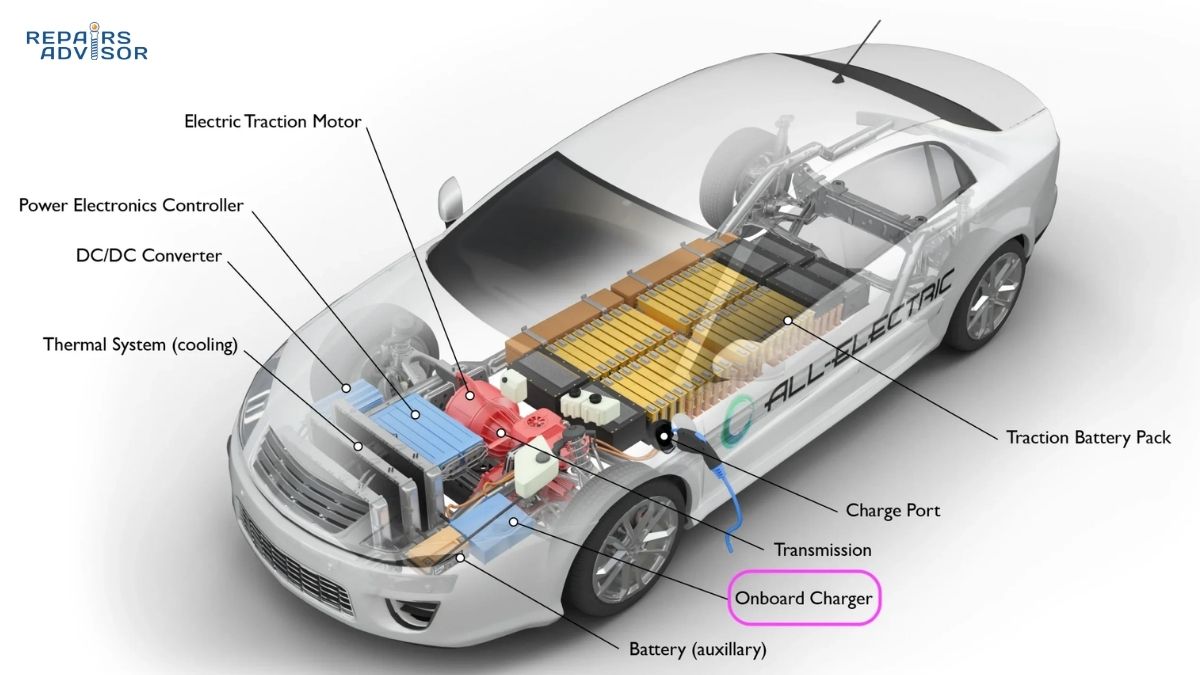
When you plug your electric vehicle into a Level 2 charging station, it’s easy to assume that station is doing the charging. Technically, it isn’t. The real conversion work happens inside your vehicle, handled by a component most EV owners never think about: the onboard charger. Understanding how it works, what breaks, and why it matters gives you a clear advantage — whether you’re tracking down a charging fault or simply trying to make sense of your vehicle’s electrical architecture.
Quick Answer
An onboard charger (OBC) is a power electronics device built into every EV and PHEV that converts alternating current (AC) from a wall outlet or Level 2 charging station into the direct current (DC) your high-voltage battery pack requires. It operates at outputs between 3.3 kW and 22 kW and manages the entire AC-to-DC conversion process internally. DC fast chargers (Level 3) bypass the OBC entirely, delivering DC directly to the battery.
What Is an Onboard Charger?
An onboard charger is a sealed power electronics module permanently installed inside the vehicle — typically in the engine bay, on the firewall, or integrated into the high-voltage junction box. Its core function is to bridge the incompatibility between the AC electricity supplied by the power grid and the DC electricity your traction battery needs.
The term “charger” creates confusion in everyday EV conversations. When most people say “EV charger,” they mean the box on the wall or the public charging station — technically called Electric Vehicle Supply Equipment (EVSE). But EVSE doesn’t charge your battery. It delivers AC power to the OBC, which converts it to DC at the correct voltage and current for your specific battery pack. The EV charging port is the physical inlet where AC enters the vehicle — the OBC is the device that actually processes it.
This distinction has immediate diagnostic value. Because DC fast charging delivers power directly to the battery without passing through the OBC, a vehicle that refuses Level 2 charging but accepts a DC fast charge is almost certainly presenting an OBC fault — not a battery fault. That single observation eliminates the most expensive possible repair from the differential.
OBC power output varies considerably by vehicle class. PHEVs with smaller battery packs often carry 3.3–6.6 kW OBCs. Full BEVs typically have 7.2–11 kW single-phase units as standard fitment, while some premium EVs use three-phase 22 kW OBCs that can cut Level 2 charging time dramatically.
The OBC’s Role in the Charging System
Trace the path from wall socket to battery and you pass through three systems in sequence: the EVSE (which regulates the AC supply and communicates safety signals), the OBC (which converts AC to DC and manages the charging process), and the Battery Management System (BMS), which interfaces directly with the high-voltage battery pack and monitors cell-level conditions during charging.
The OBC isn’t a passive converter — it actively communicates. Via CAN bus signals and pilot line negotiation with the EVSE, it verifies the charging standard in use (SAE J1772 in North America, IEC 62196 in Europe, GB/T in China), confirms system safety, and negotiates the appropriate power level before current flows. This handshake prevents incompatible hardware from damaging either the vehicle or the charging infrastructure.
The OBC also sustains the vehicle’s 12V electrical systems during charging. A DC-DC converter — typically integrated into the same module — steps down high-voltage DC to 14V, keeping ECUs, HVAC, and lighting running without draining the auxiliary battery while the traction battery replenishes.
Inside the OBC — Key Hardware Stages
Modern onboard chargers accomplish AC-to-DC conversion through four sequential processing stages. Each addresses a specific technical challenge, which is why OBCs are sophisticated — and expensive — pieces of hardware.
Stage 1 — Input Filter and Rectification
Incoming AC passes first through an input filter that suppresses high-frequency electrical noise. Without this, switching interference generated inside the OBC would propagate back onto the grid. A full-wave rectification bridge — an array of diodes — then converts the AC waveform into pulsating DC. This is still far from the stable DC the battery requires, but it’s the necessary first conversion step.
Stage 2 — Power Factor Correction (PFC)
Rectifying AC creates a phase shift between voltage and current that reduces efficiency and wastes grid capacity. The Power Factor Correction stage uses high-frequency switching elements — IGBT transistors in older designs, silicon carbide (SiC) MOSFETs in modern units — to keep input current in phase with voltage. This is the most technically demanding stage in the OBC. Well-designed PFC stages achieve approximately 98% efficiency, and their output is a stable intermediate DC bus running at around 700V — regulated enough to feed cleanly into the next stage.
Stage 3 — Isolated DC-DC Converter
The 700V intermediate bus feeds an LLC resonant DC-DC converter, which steps voltage down (or adjusts it) to the level the battery requires — typically 450–850V depending on pack design. The converter’s isolation transformer provides galvanic separation between the grid-side and battery-side circuitry: a hard electrical barrier that prevents dangerous fault currents from reaching the vehicle chassis or occupants. This voltage conversion process closely parallels the operation of the vehicle’s DC-DC converter system, though the OBC stage operates at significantly higher power levels.
Stage 4 — Control Circuit and Communication
A microcontroller manages the full charging process in real time, monitoring battery voltage, current flow, pack temperature, and state of charge simultaneously. It executes the lithium-ion charging profile: constant current (CC) mode during the main charge phase, which fills the battery quickly while keeping voltage below a safe ceiling, then transitions to constant voltage (CV) mode as the pack approaches full capacity, tapering current to top off cells safely. This CC-to-CV transition timing directly influences both charging speed and long-term battery health. The control circuit also manages external communication — negotiating power delivery with the EVSE, disabling vehicle traction via the HVIL interlock while the inlet is live, and reporting fault conditions to the vehicle’s ECU network.
Single-Phase vs. Three-Phase OBCs
One of the most practically significant OBC specifications is how many phases of AC it can utilise. Standard household power in most of the world is single-phase — one live conductor, one neutral — limiting a single-phase OBC to around 7.2–11 kW regardless of how capable the EVSE is.
Three-phase OBCs draw from all three live conductors simultaneously, which is available in most European homes and commercial premises. With three phases available, output reaches 22 kW — roughly three times a typical home wallbox. At that rate, a 77 kWh battery that would take 10 hours on a 7 kW single-phase supply charges in under four hours.
The OBC auto-detects available phases from the incoming supply and operates accordingly. Connect a three-phase OBC to a single-phase source and it defaults to single-phase operation automatically. Phase count is a meaningful cost driver: three-phase OBCs are substantially more expensive and are predominantly found on European-market premium EVs. This is one reason the same vehicle model often charges faster in Europe than in North America.
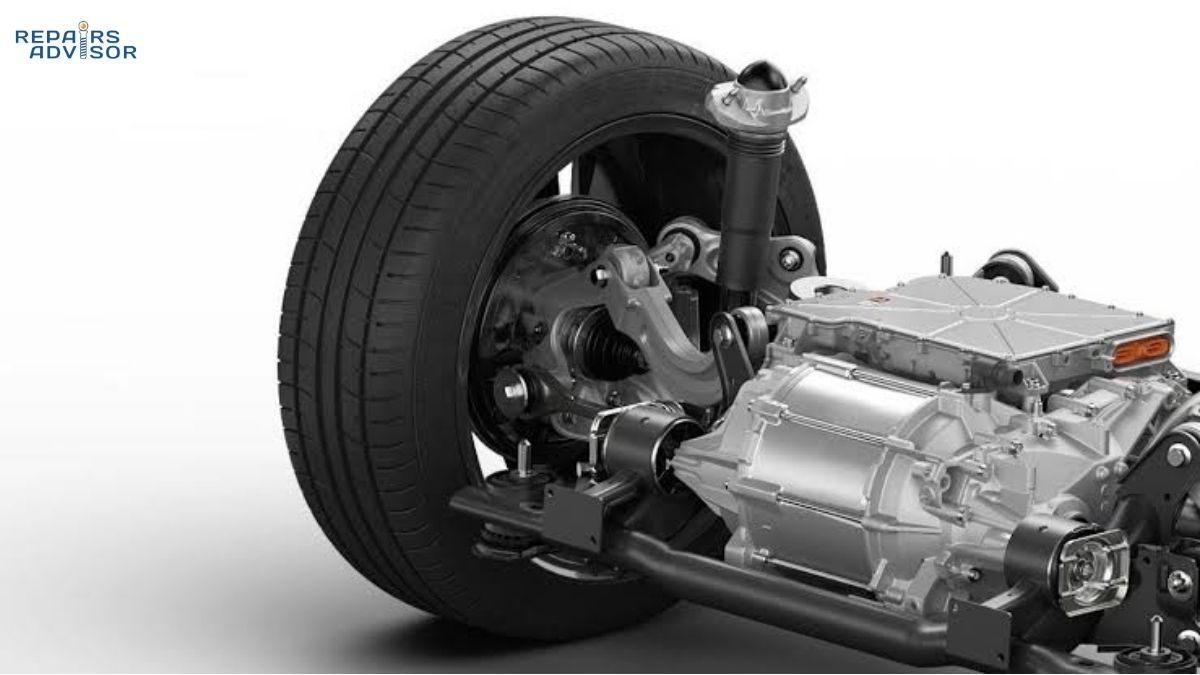
In many modern EVs, the OBC is co-packaged with related power electronics as part of an integrated EV platform, sharing a housing and liquid cooling circuit with the motor inverter and DC-DC converter to reduce weight, volume, and cost.
Bidirectional OBCs — V2L, V2H, and V2G
Conventional OBCs move energy one way: grid to battery. Bidirectional OBCs reverse the conversion process, exporting stored DC from the battery back out as AC. This capability unlocks three distinct modes depending on where the exported power goes.
Vehicle-to-Load (V2L) allows the EV to power appliances or tools via a standard adapter at the charging port — typically up to 3.6 kW. It’s the most accessible bidirectional mode, supported as standard on Hyundai and Kia E-GMP platform vehicles including the Ioniq 5, Ioniq 6, EV6, and EV9. The EV’s thermal management system monitors OBC temperatures during sustained V2L sessions, since sustained export puts different thermal demands on the converter than conventional charging.
Vehicle-to-Home (V2H) connects the EV battery to home circuits through a compatible bidirectional EVSE, enabling the vehicle to serve as backup power during outages. The Ford F-150 Lightning’s 9.6 kW Pro Power Onboard and the Nissan Leaf’s CHAdeMO-based V2H are the most established implementations to date.
Vehicle-to-Grid (V2G) extends this further — the vehicle communicates with the utility grid to provide energy during peak demand periods. V2G requires a smart grid connection and utility-approved bidirectional EVSE, and is still relatively limited in deployment as of 2026. Bidirectional OBCs increasingly use silicon carbide (SiC) and gallium nitride (GaN) switching devices instead of conventional silicon, enabling smaller, lighter modules that handle power flow in both directions efficiently.
OBC Failure — Symptoms, Diagnosis, and Safety
⚠️ HIGH VOLTAGE HAZARD: The onboard charger operates within the vehicle’s high-voltage system (400–800V). Physical inspection, testing, or replacement must only be performed by certified high-voltage technicians using appropriate Class 0 or Class 00 insulated PPE, arc-flash protection, and lockout/tagout de-energisation procedures. The information below is provided for diagnostic awareness and informed ownership only.
The Key Diagnostic Clue
The most valuable diagnostic observation when an EV won’t charge: does the vehicle accept a DC fast charge but refuse Level 2 AC? If yes, the OBC is the primary suspect. Since DC fast charging delivers power directly to the battery — bypassing the OBC entirely — a vehicle that charges on DCFC but fails on Level 2 has almost certainly experienced an OBC fault, not a battery fault. This single question eliminates the most expensive possible repair from the diagnostic tree before any tools are connected.
Common Failure Symptoms
OBC faults typically present as: complete inability to initiate any Level 1 or Level 2 charging; a session that begins normally then aborts within minutes with a “Charging Error” or “Charging System Fault” warning; abnormally slow AC charging that doesn’t correspond to cable or station limitations; unusual fan noise from the OBC’s cooling circuit during charging; or a cascade of secondary warnings — HV battery faults, 12V battery faults, or “Do Not Tow” messages — in severe cases.
Common Root Causes
OBC hardware failures tend to emerge in a predictable range — most commonly between 100,000 and 155,000 km — reflecting normal wear on power electronics subjected to continuous thermal cycling. Grid voltage instability, power surges, internal short circuits, and moisture ingress are additional contributors. Software-related communication failures can present identically to hardware faults and are frequently resolved by an OEM firmware update, so always verify software currency before condemning hardware. The battery thermal management system also plays a role: sustained charging at elevated pack temperatures accelerates degradation in the OBC’s control electronics over time.
Technician Diagnosis Protocol
Systematic OBC diagnosis starts with fault code retrieval and communication error review — not parts replacement. Cross-testing on both Level 2 AC and DCFC isolates whether the fault domain is the OBC, the EVSE handshake, or an associated system. If the isolation monitoring device logs faults during charging sessions, OBC insulation breakdown is the likely finding. HVIL faults triggered at the charge inlet may reflect OBC communication issues rather than a physical interlock failure — a distinction scan data can usually clarify.
OBC Replacement — Costs, Procedures, and Service Manuals
OBC replacement is exclusively a professional procedure. Service work requires HV system de-energisation by a certified technician — beginning with disabling the HV contactors and confirming zero volts at the HV bus before any contact with related hardware. On crash-damaged vehicles, confirm whether the pyro-fuse system has activated — a fired pyro fuse means the HV system was automatically disconnected at impact and requires verification before proceeding.
OBC parts cost typically ranges from $3,000 to $6,000+ depending on vehicle and whether the unit is OEM new, remanufactured, or salvage-sourced. Labor adds $800–$1,500 for physical R&R and — critically — OEM programming. A replacement OBC must be calibrated to the vehicle using manufacturer diagnostic tools (XENTRY for Mercedes, ISTA for BMW, or equivalent OEM software). An uncoded unit will not function correctly regardless of physical condition. This programming requirement means shops without OEM tooling access cannot complete the repair, and used OBC units carry significant risk if part numbers don’t match the vehicle’s VIN exactly.
Before authorising any replacement, verify warranty status. Many manufacturers extend 8–10 year coverage to high-voltage components including the OBC — this warranty may remain valid even after the standard bumper-to-bumper coverage has expired.
For vehicle-specific de-energisation sequences, torque specifications, connector identification, and programming procedures, OEM service manuals are the authoritative reference. Technical documentation for major EV platforms is available for Tesla, BMW, Nissan — whose Leaf OBC is among the most extensively documented in the independent service community — and Toyota hybrid and electric platforms.
The Onboard Charger’s Place in the Bigger Picture
The onboard charger is one of the least visible but most consequential components in an electric vehicle. It works silently every charging session, performing a demanding power conversion task that directly determines how quickly and safely your battery replenishes. When it fails, the impact is immediate: Level 2 charging stops entirely, leaving the vehicle dependent on DC fast chargers until the fault is resolved — a significant inconvenience in regions where DCFC infrastructure is still developing.
Understanding OBC architecture pays dividends whether you own an EV or service them. You know why the charging station is not actually the “charger.” You know why a Level 2 fault with functioning DCFC points to the OBC before the battery. You know that bidirectional OBCs are gradually transforming EVs from pure energy consumers into platforms that can distribute stored energy back to homes and grids. And you know that any physical intervention on the OBC belongs exclusively to professionals with the certification, tools, and training to work safely within high-voltage systems. The traction motor ultimately uses the energy the OBC has converted and stored — but without the OBC working reliably in the background, every kilometre of electric driving depends on finding a fast charger instead.
Onboard Charger FAQ: Common Questions About EV OBC Systems
The onboard charger (OBC) is one of the least visible but most essential systems in any electric or plug-in hybrid vehicle. From basic definitions to fault diagnosis and replacement costs, these are the questions EV owners and technicians ask most often.
Quick Answer
An onboard charger is the power electronics device inside your EV that converts AC electricity from a wall outlet or Level 2 charging station into the DC voltage your battery pack needs. Without it, AC charging cannot occur. DC fast charging bypasses the OBC entirely, which is why OBC failures only affect Level 1 and Level 2 charging.
What does an onboard charger actually do?
The onboard charger converts alternating current (AC) from an external power source — a household outlet, a Level 1 or Level 2 charging station — into direct current (DC) at the voltage and current level your battery pack requires. It’s the critical intermediary between the power grid and your traction battery. The external charging station (EVSE) doesn’t charge your battery directly; it supplies AC to the OBC, and the OBC does the actual charging. The EV charging port is simply the physical inlet — the OBC processes everything that enters through it.
Is the onboard charger the same as the charging station?
No. These are two separate devices that work together. The charging station (EVSE) is external to the vehicle — it regulates the AC power supply, communicates safety signals, and establishes the charging handshake. The onboard charger is internal, permanently installed in the vehicle, and performs the actual AC-to-DC power conversion. When people say “my charger is slow,” they may be referring to either device — the OBC sets the ceiling for how fast AC charging can occur, but the EVSE must also be capable of supplying that power level.
Does the onboard charger affect charging speed?
Yes — it’s one of the primary limiting factors. The OBC’s power rating (in kW) defines the maximum rate at which it can convert AC power into battery charge. If your OBC is rated at 7.2 kW, a 22 kW charging station can’t charge your vehicle any faster than 7.2 kW — the OBC is the bottleneck. The charging speed you actually experience is always limited by whichever link in the chain is weakest: the EVSE output, the OBC rating, or the battery’s own acceptance rate. Increasing the EVSE power output beyond the OBC’s rating delivers no benefit.
Does the onboard charger work during DC fast charging?
No. DC fast chargers (Level 3) bypass the onboard charger entirely. Instead of supplying AC power for the OBC to convert, they perform the AC-to-DC conversion externally and deliver DC directly to the battery pack at high power. This is why DC fast charging is so much faster than Level 2 — the OBC’s power rating no longer limits the charge rate. Understanding this distinction is also the most useful diagnostic clue available: if your vehicle charges normally at a DC fast charger but fails on Level 1 or Level 2, the DC fast charging system is functioning and the OBC is the likely fault.
What is the difference between single-phase and three-phase OBCs?
Single-phase OBCs draw from one live AC conductor — the type available at standard household outlets globally. Their practical maximum output is around 7.2–11 kW. Three-phase OBCs draw from all three live conductors simultaneously, which is available in most European homes and commercial premises, and can reach 22 kW — roughly three times the speed of a typical home wallbox. Three-phase OBCs are more expensive to manufacture and are predominantly found on European-market premium EVs. The OBC auto-detects how many phases are available and adjusts accordingly, so a three-phase capable OBC will work on a single-phase supply, just at reduced speed.
What is a bidirectional onboard charger?
A bidirectional OBC can reverse the conversion process — taking DC from the battery and exporting it as AC. This enables Vehicle-to-Load (V2L) capability, which lets the car power appliances through the charging port; Vehicle-to-Home (V2H), which allows the vehicle to supply electricity to your home circuits; and Vehicle-to-Grid (V2G), where the car feeds energy back to the utility grid. Bidirectional OBCs use advanced switching devices such as silicon carbide (SiC) MOSFETs to handle power flowing in both directions efficiently. Not all EVs have bidirectional OBCs. Check your vehicle’s specifications to confirm V2L, V2H, or V2G capability before purchasing a compatible bidirectional home charger.
How do I know if my onboard charger is failing?
The clearest sign is the combination of: AC charging fails on all Level 1 and Level 2 equipment, but DC fast charging still works normally. Additional symptoms include a charging session that starts and then aborts within a few minutes with a fault warning; abnormally slow AC charging that doesn’t match the cable or station’s rated output; unusual fan noise during charging; or a cluster of dashboard warnings including battery fault codes or “Do Not Tow” messages in severe cases. Because OBC faults only affect AC charging, the DC fast charging test is the fastest way to isolate the problem before involving a technician. Also check for available OTA software updates — communication-related OBC faults are sometimes resolved by a firmware update without any hardware replacement.
Can I diagnose or repair the onboard charger myself?
The OBC operates within the vehicle’s high-voltage system at 400–800V — sufficient to cause fatal electrocution. Physical inspection, testing, or replacement must only be performed by certified high-voltage technicians using Class 0 or Class 00 insulated PPE, arc-flash protection, and lockout/tagout de-energisation procedures. What you can safely do yourself: confirm the fault pattern (Level 2 fails, DCFC works), check for software updates through the vehicle’s app or settings, and document any fault codes or warning messages to help the technician. Providing clear fault information before the appointment often reduces diagnostic time and cost. For background on the HV safety systems involved, the HVIL system and isolation monitoring device articles explain what technicians check during OBC diagnosis.
How much does onboard charger replacement cost?
OBC replacement is among the more expensive EV repairs outside of battery replacement. Parts typically range from $3,000 to $6,000+ depending on vehicle make, whether the unit is OEM new or remanufactured, and part number complexity. Labor adds $800–$1,500 for the physical R&R plus the mandatory OEM programming step — a replacement OBC must be calibrated to the vehicle using manufacturer diagnostic software, which means shops without OEM tooling access cannot complete the job. Before authorising any replacement, confirm warranty status: many manufacturers cover high-voltage components including the OBC under an extended 8–10 year warranty that may still be valid even after standard warranty expiry. Service manual documentation for major EV platforms — including Tesla, BMW, Nissan, and Toyota — covers de-energisation procedures and programming requirements specific to each platform.
Does the onboard charger affect battery health?
Indirectly, yes. The OBC manages the CC-to-CV charging profile — the transition from constant current (fast, bulk charging) to constant voltage (slower, top-off charging) — which directly influences cell stress during each session. A well-functioning OBC executes this profile correctly, minimising degradation. A degraded OBC that charges erratically or at incorrect voltage levels can contribute to accelerated cell wear. Separately, AC charging through the OBC is generally gentler on battery chemistry than repeated DC fast charging, because DC fast charging bypasses the OBC’s profile management. The battery thermal management system works in parallel with the OBC to keep pack temperatures in range during charging, since elevated temperatures during charging accelerate degradation regardless of charge rate.
How long does an onboard charger last?
OBC hardware failures tend to occur in the range of 100,000–155,000 km of use for most vehicles, reflecting normal wear on power electronics subjected to repeated thermal cycling. This is a generalisation — some units fail earlier due to grid voltage instability, moisture ingress, or manufacturing variation, while others last the vehicle’s full service life without intervention. Software-related faults can occur at any mileage and are often resolved by OTA updates. Regular Level 2 AC charging (rather than relying primarily on DC fast charging) is generally considered the better long-term habit for both battery and OBC health. If you experience any of the failure symptoms described above, having the system scanned promptly — before a minor fault develops into a complete failure — may reduce repair scope and cost.