Electric vehicles are, in a sense, victims of their own efficiency. A petrol engine wastes so much energy as heat that there’s always plenty left over to warm the cabin for free — the heater core just borrows from that thermal overflow. An EV drivetrain has no such surplus. It converts energy to motion so cleanly that there’s almost nothing left to scavenge, which creates a real problem in winter: where does cabin heat come from? The answer, increasingly, is a heat pump — a refrigerant-cycle system that moves thermal energy rather than generating it, and one of the most important technologies shaping modern EV range performance.
Quick Answer
An EV heat pump HVAC system uses a reversing valve, electric compressor, refrigerant chiller, and coolant coupling to move heat into or out of the cabin and battery — rather than generating heat directly. In heating mode, the system extracts thermal energy from outside air and drivetrain waste heat, delivering 2–4 units of heat for every 1 unit of electricity consumed (COP 2–4). This makes it 200–400% more efficient than a resistive electric heater and can reduce winter range loss by 10–30%. All refrigerant and high-voltage components require certified technician service — this is not a DIY system.
Why EVs Need a Different Heating Solution
In a conventional car, the engine is the cabin heater’s best friend. Combustion engines convert roughly 30–40% of fuel energy into motion — the remaining 60–70% escapes as heat. A small fraction of that heat is captured via the heater core, which passes hot coolant through a small radiator in the dashboard. Air blown across it warms the cabin. The energy cost to the driver: essentially zero, because the heat was going to waste anyway.
EVs have no combustion, so there’s no free thermal overflow. The traction battery, motor, and power electronics do generate some waste heat under load, but nowhere near enough to heat a cabin on a cold morning. The traditional fallback is a resistive heater — essentially an electric element, like a toaster element built into the ventilation duct. It works, and it’s reliable even in extreme cold, but it draws power directly from the traction battery, competing with the motor for energy. At temperatures around 0°C, a resistive heater can cut driving range by 30–40%. At -20°C, that impact is even more severe.
High-voltage heaters (HVH) are a simpler evolution — they use water as a heat transfer medium instead of a heating element directly in the airstream, and are lighter and less complex than heat pumps. But they still generate heat electrically at a 1:1 conversion ratio, which is fundamentally less efficient. The heat pump solves this by not generating heat at all. It moves heat from where it exists to where it’s needed — and in doing so, it delivers far more thermal energy than the electricity it consumes.
Core Components of an EV Heat Pump System
A conventional automotive A/C system has four main components: compressor, condenser, expansion valve, and evaporator. An EV heat pump uses those same foundations but adds a reversing valve, a chiller (refrigerant-to-coolant heat exchanger), and a software-controlled thermal distribution loop. Together, these additions transform a one-directional cooling system into a bidirectional thermal management platform that can heat, cool, and condition multiple circuits simultaneously.
Electric Compressor
In an ICE vehicle, the A/C compressor is driven by a belt off the engine crankshaft — it only runs when the engine is running, and its operation is a parasitic load on the drivetrain. The EV heat pump uses an electric compressor powered directly from the high-voltage battery. The motor, inverter, and compressor mechanism are integrated into a single sealed unit. Because it’s electrically powered rather than mechanically coupled, it can run at any time, including when the vehicle is parked and plugged in — which is what makes cabin pre-conditioning possible. Variable-speed operation also means the compressor can modulate output precisely to match thermal demand, improving efficiency across a wider operating range than a fixed-displacement belt-driven unit.
Reversing Valve
This is the component that makes a heat pump a heat pump rather than just an air conditioner. The reversing valve is a four-port solenoid-controlled valve that redirects the flow of refrigerant through the system. Understanding the refrigerant cycle helps here: in any vapour-compression system, the side of the circuit where refrigerant expands and vaporises absorbs heat (this is the evaporator), and the side where it condenses back to liquid releases heat (this is the condenser).
In cooling mode, the indoor coil acts as the evaporator — it absorbs heat from cabin air, chilling it before it’s blown back into the passenger compartment. The outdoor coil is the condenser, releasing that heat to the outside air. When the reversing valve switches, the refrigerant flow direction reverses. Now the outdoor coil becomes the evaporator — it absorbs heat from the outside air, even at sub-zero temperatures. The indoor coil becomes the condenser, releasing that heat into the cabin. The result: heat is being pumped in from outside, not generated inside. When the reversing valve fails — typically due to solenoid burnout, internal wear, or contamination — the system gets stuck in one mode. A car that heats but won’t cool, or cools but won’t heat, is a classic reversing valve failure signature.
Chiller (Refrigerant-to-Coolant Heat Exchanger)
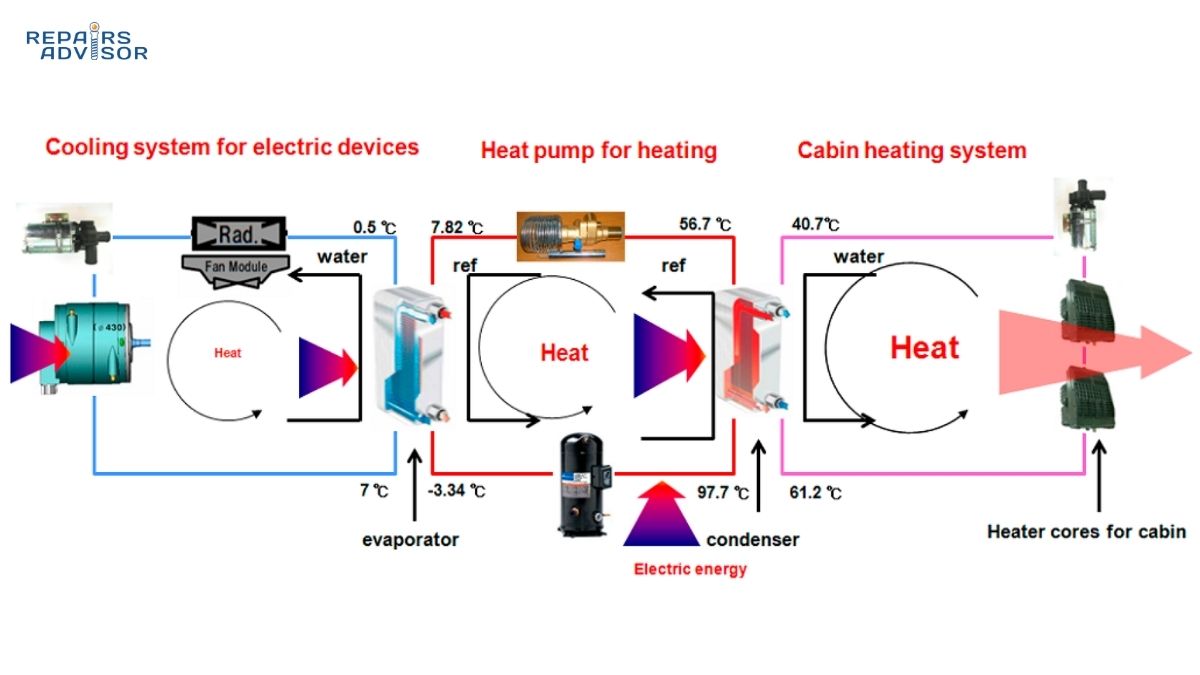
The chiller is where the heat pump integrates with the vehicle’s broader battery thermal management system. It’s a compact heat exchanger that couples the refrigerant circuit to the battery coolant loop. In heating mode, the chiller functions as an additional evaporator — refrigerant flows through it and absorbs waste heat from the battery coolant, motor coolant, and power electronics cooling circuits. This heat would otherwise be rejected to ambient air; the chiller captures it and pumps it into the cabin heating circuit instead. The practical effect is that the heat pump scavenges free thermal energy from the drivetrain rather than discarding it, significantly boosting system COP in moderate cold. In cooling mode, the chiller reverses its function — refrigerant chills the battery coolant loop, keeping the pack within its optimal temperature window during fast charging or sustained high-power operation.
Electronic Expansion Valves
Traditional automotive A/C systems use either a fixed orifice tube or a thermostatic expansion valve (TXV) to control refrigerant flow. EV heat pump systems typically use multiple electronic expansion valves (EEVs) — stepper motor-driven expansion devices that the vehicle’s thermal management controller can adjust in real time. This matters because the system often needs to direct refrigerant to more than one circuit simultaneously: heating the cabin while also conditioning the battery, for instance. EEVs enable that multi-circuit routing with precise flow control, which is not possible with fixed orifice hardware.
Coolant Coupling and Thermal Distribution Loop
The heat pump doesn’t operate in isolation — it’s one node in a vehicle-wide thermal network. The coolant coupling connects the refrigerant circuit to multiple coolant loops: the battery thermal circuit, the motor and inverter cooling circuits, and the cabin heating circuit. In modern integrated thermal management designs — particularly in vehicles with e-axle integration where motor, inverter, and gearbox share a compact thermal envelope — the software continuously decides how to route heat between circuits based on driver demand, ambient conditions, battery state of charge, and charging status. This level of integration is why diagnosing EV HVAC problems requires scan tool data, not just physical inspection.
How the System Operates in Each Mode
Heating Mode
In heating mode, the refrigerant cycle works as follows. The electric compressor draws low-pressure refrigerant vapour and compresses it, raising both its pressure and temperature. The high-pressure, high-temperature refrigerant flows through the reversing valve to the indoor condenser — the coil in the cabin heater unit. Here, the refrigerant condenses back to liquid, releasing its heat energy into the airstream that warms the passenger compartment. The now-liquid refrigerant passes through an electronic expansion valve, dropping sharply in pressure and temperature. It then enters the outdoor evaporator, where it vaporises by absorbing heat from the outside air — even when that air is well below freezing, because the refrigerant temperature after expansion is lower still. Simultaneously, refrigerant also flows through the chiller, absorbing waste heat from drivetrain coolant loops. The low-pressure vapour returns to the compressor, and the cycle repeats.
There are limits. As outside air temperature drops toward -10°C and beyond, there’s progressively less thermal energy available in the ambient air to extract. The COP falls as the compressor has to work harder to achieve the same temperature lift. Most EVs blend in the resistive backup heater at extreme low temperatures — it’s less efficient, but it’s reliable when the heat pump’s COP advantage shrinks. This is why EVs in genuinely arctic climates still experience meaningful range reduction in winter even with heat pump equipped: below a certain threshold, physics constrains what the heat pump can deliver.
Cooling Mode
In cooling mode, the reversing valve switches refrigerant flow direction and the system operates identically to a conventional A/C system: indoor coil as evaporator absorbing cabin heat, outdoor coil as condenser rejecting it to the air. The chiller simultaneously cools the battery coolant loop — particularly useful during fast charging when the pack generates significant heat and needs active cooling to maintain performance and longevity.
Cabin Pre-Conditioning
One of the most practically useful features enabled by the electric compressor is cabin pre-conditioning. Because the compressor runs off the HV battery independently of the drivetrain, the system can operate while the vehicle is plugged into a charger. This means the heat pump can bring the cabin and battery to target temperatures using grid electricity, not battery energy. The driver arrives at a warm car with a full state of charge, rather than a warm car that’s already burned 5–8% of its range on heating. Pre-conditioning the battery to its optimal operating temperature also improves both range and DC fast charging acceptance — cold lithium cells charge more slowly and at lower power limits. The vehicle’s software typically prioritises battery conditioning over cabin comfort in extreme cold, warming the pack first to maximise driving range.
Efficiency: The COP Advantage
The Coefficient of Performance (COP) is the ratio of heat delivered to electrical energy consumed. A resistive heater has a COP of 1.0 — one unit of electricity in, one unit of heat out, by definition. A heat pump, because it’s moving existing heat rather than generating it, can deliver significantly more thermal energy than it consumes in electricity. At typical UK and Australian winter temperatures (around 7°C / 45°F), a well-designed EV heat pump runs at approximately COP 3.5–4.0 — meaning four units of heat for every unit of electricity consumed. Even at -10°C, most modern systems maintain COP above 2.0, still twice as efficient as a resistive heater running full power.
In practical range terms, U.S. Department of Energy data shows that a heat pump can reduce HVAC energy consumption by approximately 38% compared to resistive-only heating at 20°F (-7°C). Real-world winter range improvement with a heat pump typically runs 10–30% depending on climate, driving pattern, and vehicle architecture. The efficiency advantage is most pronounced in the -5°C to +15°C temperature band — exactly the range that covers the bulk of winter driving in temperate climates like much of Australia, the UK, and Northern Europe.
The heat pump’s interaction with the vehicle’s DC-DC converter and 12V system is also worth noting: the HV heat pump draws from the traction battery, while ancillary HVAC controls (blower motors, blend door actuators, control modules) run from the 12V system the DC-DC converter maintains. A failed DC-DC converter can therefore produce HVAC control symptoms that superficially resemble compressor or refrigerant issues — another reason system-level diagnostics matter.
⚠️ High Voltage Safety and Service Boundaries
The EV heat pump operates within the vehicle’s high-voltage electrical architecture. The electric compressor runs at traction battery voltage — typically 400V or 800V depending on the platform. The chiller connects directly to battery thermal management circuits. Refrigerant work always requires certification under Australian and international equivalent regulations (analogous to EPA 609 in the U.S.). Working in proximity to HV components without proper training, insulated tools, and the correct personal protective equipment creates a risk of electrocution that is not mitigated by switching off the 12V ignition — the HV system can remain live.
The High Voltage Interlock Loop (HVIL) is the first line of protection: a continuous low-voltage signal circuit that detects when any HV connector is unseated and commands the system to de-energise. But the Isolation Monitoring Device (IMD) continuously checks insulation integrity across the HV system during operation, and the HV contactors control power flow from the battery. Even after the contactors open, residual charge in capacitors within the inverter and compressor drive circuits can be lethal for several minutes. Pyro-fuse systems provide a final layer of crash protection, but these safety systems protect against specific scenarios — they do not make the HV system safe for uninstructed work.
For technicians working on these systems, the diagnostic process starts with scan tool data: compressor command signals, system-side pressure sensor readings, temperature sensor values across refrigerant and coolant circuits, and compressor amperage draw. Proper diagnosis requires static and dynamic pressure testing across both refrigerant sides, compressor amperage measurement under load, and refrigerant quality evaluation. Moisture or debris contamination is a common cause of premature failure on replacement compressors when the root cause wasn’t addressed before the new part was installed. Fault codes point toward areas of investigation, not confirmed diagnoses — the same code can appear from low refrigerant charge, a stuck expansion valve, a failed pressure sensor, or actual compressor failure.
All refrigerant recovery, recharge, and HV compressor work requires a certified technician. This is an information article about system function, not a service procedure. Consult your vehicle’s official workshop manual and ensure any service is performed by a qualified EV/HV technician.
Common Symptoms of Heat Pump Problems
Because the heat pump integrates refrigerant and high-voltage electrical systems with the battery thermal management network, symptoms don’t always trace cleanly to a single component. These are the patterns technicians see most frequently:
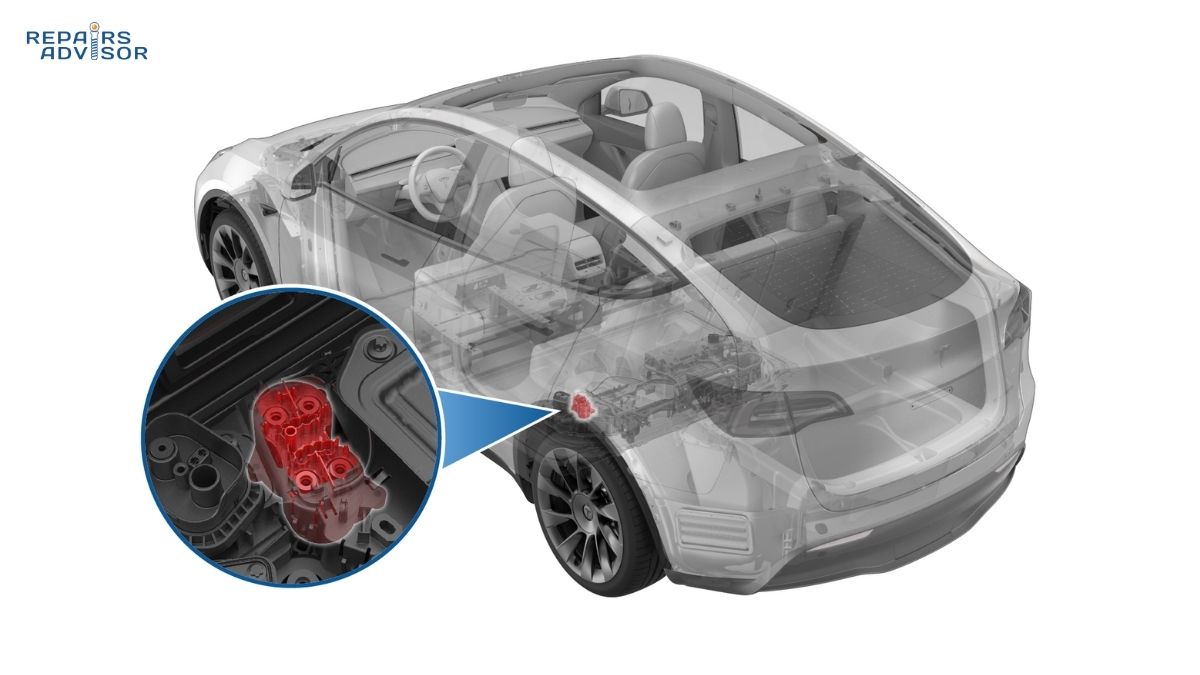
No cabin heat in winter, but cooling works normally. The most common presentation of heat pump compressor failure. When the compressor fails, the heating side stops — the reversing valve can switch, but there’s no pressure differential to drive heat exchange. Cooling may still function if the compressor produces some output at lower pressure differentials. For Tesla Model 3 and Model Y owners, fault codes VCFRONT_a447 and VCFRONT_a531 are specifically associated with heat pump compressor failure and super-manifold assembly issues.
Gradual reduction in heating performance over several weeks. Slow refrigerant loss is the most likely culprit. A small leak won’t produce an immediate failure — it will progressively reduce system capacity. If a compressor replacement is being considered, the system should be pressure-tested for leaks first; installing a new compressor into a system with an existing leak accelerates failure of the replacement unit.
System heats or cools, but not both. The classic reversing valve symptom. The valve may be mechanically stuck (worn internal slider, debris), or the solenoid coil may have failed electrically. A technician can test solenoid resistance and voltage, listen for the characteristic click when mode switching is commanded, and check for the temperature differential shift across the valve ports that indicates it is or isn’t switching properly.
Winter range is significantly worse than expected, no fault codes present. The heat pump may be running in degraded mode — operating but not efficiently. Possible causes include partial refrigerant loss, an early-stage failing compressor, or a chiller not properly coupling drivetrain heat sources. Scan tool data across the thermal management system is needed to identify the weak point.
Dashboard climate warnings alongside unusual compressor noise. Bearing degradation, refrigerant contamination, or internal compressor damage. Prompt service matters — a failing compressor can contaminate the circuit with debris that destroys a replacement unit if the system isn’t properly flushed before installation.
The Heat Pump as Standard Equipment
Heat pumps have moved from optional extra to standard fitment across the EV industry at pace. BMW, Porsche, and Tesla now include them as standard. Renault includes them on all UK models. Hyundai’s IONIQ 5 and 6, Kia’s EV6 and EV9, and Volkswagen’s ID family offer them as standard or near-standard equipment. The industry trend is clear: as EVs expand into colder climates and customers become more range-conscious, a heat pump is no longer a premium feature — it’s a baseline expectation.
For technicians, EV heat pump diagnostics represent a significant skill expansion beyond traditional HVAC. The system intersects refrigerant circuit knowledge, HV electrical competency, battery thermal management understanding, and software-driven thermal routing logic. Working knowledge of complementary systems — including regenerative braking‘s contribution to waste heat recovery, onboard charger thermal integration, and how pre-conditioning interacts with DC fast charging arrival preparation — rounds out the diagnostic picture.
For EV owners, understanding how the heat pump works helps explain why winter range is better than it would otherwise be, why pre-conditioning matters, and what the symptoms of a failing system look like before a complete loss of cabin heat. For service, always consult the official workshop manual for your specific vehicle — EV heat pump architectures vary meaningfully between manufacturers and model years — and ensure work is performed by a certified HV technician.
EV Heat Pump HVAC: Frequently Asked Questions
The EV heat pump is one of the technologies that makes the biggest practical difference to how an electric vehicle behaves in the real world, yet it often appears as a footnote on a spec sheet. If you’re trying to understand how it works, whether your vehicle has one, what happens in extreme cold, or what warning signs to watch for, these questions cover what owners and technicians ask most.
Quick Answer
An EV heat pump moves thermal energy from ambient air and drivetrain waste heat into the cabin instead of generating heat directly, making it 2–4 times more efficient than a resistive electric heater. It works effectively down to around -15°C (5°F), after which a resistive backup heater supplements. Heat pumps cannot be retrofitted after purchase, are not standard on all EVs, and require certified technician service for any refrigerant or high-voltage work.
How does an EV heat pump actually work?
The short version: it runs the automotive refrigeration cycle in reverse. A conventional A/C system moves heat from inside the cabin to the outside air to cool the car. A heat pump adds a reversing valve that flips the refrigerant flow direction, so the system can also extract heat from outside air and pump it into the cabin for heating. The same electric compressor handles both functions. In heating mode, refrigerant expands and absorbs heat from ambient air at the outdoor coil, then that heat is released at the indoor condenser to warm the cabin. Because the system is transferring existing heat rather than generating new heat, it delivers 2–4 units of thermal energy for every 1 unit of electricity consumed — which is where the efficiency advantage comes from. For a deeper look at the full component breakdown, the EV heat pump HVAC guide covers each component in detail.
Does an EV heat pump work in freezing temperatures?
Yes, but with diminishing efficiency as temperatures fall. Heat pumps work by extracting thermal energy from outside air — and even very cold air contains usable heat. Modern EV heat pump systems operate effectively down to approximately -15°C (5°F). Between -5°C and +15°C, the efficiency advantage over resistive heating is at its most pronounced, which is why heat pumps make the biggest difference during the kind of cold that characterises autumn and winter in most temperate climates.
Below -15°C to -20°C, there’s progressively less heat in the ambient air to extract, and the compressor has to work harder to achieve the same temperature lift. At this point, most EVs blend in or fully switch to the resistive backup heater. The COP (Coefficient of Performance) in extreme cold can drop to around 1.5–2.0, which still offers some efficiency advantage over pure resistive heating, but the gap narrows significantly. The traction battery itself also becomes less chemically efficient at low temperatures, compounding the winter range effect regardless of heating method.
How much range does a heat pump actually save?
Real-world data points to a 10–30% range improvement in cold conditions compared to resistive-only heating, depending on climate, driving pattern, and how integrated the system is with the battery thermal management circuit. U.S. Department of Energy data shows heat pump-equipped EVs reduce HVAC energy draw by approximately 38% at 20°F (-7°C) compared to resistive-only systems. A Move Electric winter range test found that EVs with heat pumps fell short of their official range by an average of 25.4%, while those without resistive heating suffered a 33.6% deficit — a meaningful real-world gap.
The benefit is most noticeable in city driving, where speeds are lower and proportional HVAC draw is higher relative to traction energy, and least noticeable in extreme cold (below -15°C) or in very mild climates where the heater isn’t heavily used anyway. Pre-conditioning while plugged in — running the heat pump off grid power to warm the cabin and battery before departure — extends the effective range benefit further by reducing how hard the system needs to work once you’re driving.
How do I know if my EV has a heat pump?
The most reliable method is to check the official specification sheet for your specific model year and trim level. On the manufacturer’s website or owner portal (most allow VIN lookup), search for “heat pump,” “thermal pump,” or “cold weather package.” On used EVs, the original Monroney sticker or dealer build sheet is the authoritative source — trim and model year matter, because some manufacturers offered heat pumps only on upper trims or in certain market regions, and two visually identical vehicles from different model years can have different heating hardware.
If documentation isn’t available, a qualified technician can inspect the refrigerant circuit for the additional valves, chiller, and routing complexity that distinguish a heat pump system from a cooling-only A/C system. Monitoring energy consumption in cold weather is a rough indicator — if cabin heating draws noticeably less energy than similar EVs without heat pumps — but this isn’t a definitive test. As of 2025–2026, heat pumps are standard across Tesla, BMW i-series, Porsche, Renault, Hyundai IONIQ 5/6, Kia EV6/EV9, and GM Ultium-platform vehicles, among others. Availability on older or lower-trim models varies widely.
Can a heat pump be retrofitted to an EV that doesn’t have one?
No. EV heat pump systems are factory-integrated into the vehicle’s thermal management architecture — the refrigerant routing, control software, coolant loops, and battery thermal management system are all engineered together as a unified system. There is no aftermarket retrofit path. If winter range efficiency matters and your current vehicle lacks a heat pump, it is a consideration for the next purchase rather than an upgrade to the current one. This is worth factoring in when evaluating used EVs from 2020–2023, when heat pump fitment was inconsistent across trims and markets.
Why does my EV blow cool air briefly when the heater is first turned on?
This is normal heat pump behaviour, and it surprises many owners used to petrol cars or EVs with resistive heaters. When the heat pump starts up in cold conditions, it takes a short time for the refrigerant circuit to build up sufficient pressure and temperature differential to deliver warm air. The electric compressor needs to run through a few cycles before the condenser reaches heating temperature. Depending on ambient conditions, this startup lag can last 30–90 seconds. A related behaviour is periodic brief switches to cooler air during cabin dehumidification cycles — the system momentarily runs in cooling mode to dry the air and prevent windscreen fogging, then returns to heating. This is intentional, not a fault.
If cool air persists for several minutes after startup in conditions where the heat pump should be operating, or if the system never transitions to warm air delivery, that is worth having diagnosed — it may indicate low refrigerant charge, a reversing valve issue, or early compressor degradation.
What is cabin pre-conditioning and does it use the heat pump?
Cabin pre-conditioning is the ability to warm (or cool) the cabin and battery to target temperatures before the vehicle is driven, using grid electricity while the car is still plugged in rather than drawing from the traction battery. Yes, it uses the heat pump when heat pump heating is the mode in use — the electric compressor runs off the HV battery, which in turn is being replenished by the charger, so the net effect is that the cabin arrives at temperature without any meaningful battery cost.
Pre-conditioning the battery as well as the cabin is particularly valuable in cold weather. Cold lithium cells charge more slowly and at reduced power limits, so a pre-warmed battery accepts DC fast charging at higher rates and delivers more usable range. Many EVs pre-condition the battery automatically when a DC fast charger is set as a navigation destination — the thermal system begins warming the pack during the drive to optimise charge acceptance on arrival. This is separate from cabin pre-conditioning and happens without driver input.
Why does the heat pump seem less effective at highway speeds in cold weather?
At high speeds, traction energy demand rises significantly, and the total energy budget of the battery is being consumed faster. The heat pump’s absolute efficiency advantage — say, saving 2–3 kW versus a resistive heater — becomes proportionally smaller relative to the 20–30+ kW of traction demand at highway speeds. In city driving, where traction loads might be 8–12 kW, cutting HVAC draw by 2–3 kW is a substantial proportional saving. The heat pump itself isn’t less effective at highway speed, but its contribution to overall range is diluted by higher traction energy consumption.
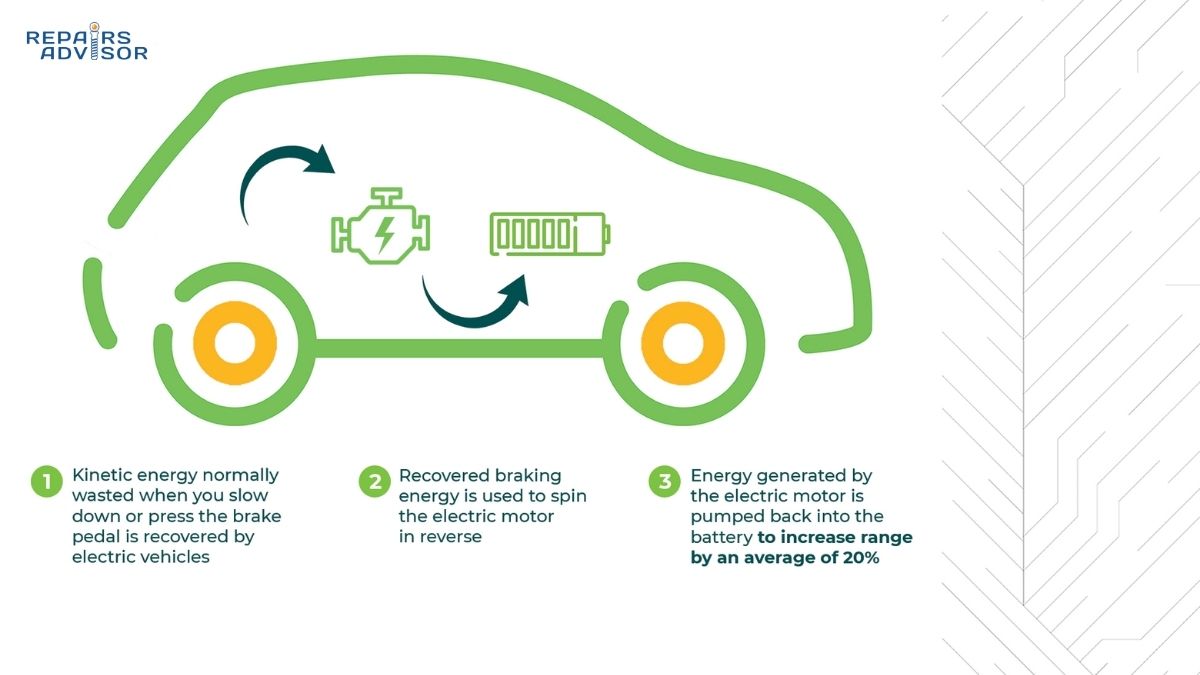
Cold-soaked batteries at highway speeds also present the compounding factor: battery chemistry reduces available energy at low temperatures, so both the numerator (driving efficiency) and denominator (usable energy) of the range equation are affected simultaneously. Regenerative braking is also less effective on cold batteries that can’t accept charge as readily, further reducing the energy recovery that partly offsets highway HVAC loads.
What are the signs that the heat pump is failing?
The clearest sign is loss of cabin heat in winter while cooling still functions normally — this points to compressor failure or a reversing valve issue. Gradual reduction in heating performance over several weeks, rather than sudden failure, suggests slow refrigerant loss. A system stuck in one mode (heats but won’t cool, or cools but won’t heat) is characteristic of a reversing valve fault — either the solenoid has failed electrically or the valve is mechanically stuck. Unusual noise from the compressor area — particularly clicking, grinding, or rattling sounds — warrants prompt assessment.
Dashboard fault codes related to climate performance or compressor circuits are a signal to investigate, but a code alone doesn’t identify the root cause. The same code can appear from low refrigerant charge, a stuck expansion valve, a failed pressure sensor, or actual compressor failure. Professional diagnosis using pressure testing and compressor amperage measurement under load is required to identify the specific fault before committing to component replacement.
Can I service the heat pump myself?
No. EV heat pump systems involve two categories of hazard that require professional certification and equipment: refrigerant handling, and high-voltage electrical systems. Refrigerant work requires certification under applicable regulations in all major markets. The electric compressor operates at traction battery voltage — 400V or 800V depending on the platform — and the system connects directly to the battery thermal management circuitry. Safety systems including the High Voltage Interlock Loop and Isolation Monitoring Device protect against specific fault conditions but do not make the HV system safe for uninstructed work. Diagnosis, refrigerant recovery and recharge, compressor replacement, and any work on the refrigerant circuit must be performed by a certified HV technician using appropriate insulated tools and personal protective equipment.
Does the heat pump affect the cooling system in summer?
In cooling mode, an EV heat pump operates identically to a conventional automotive A/C system — the reversing valve returns the refrigerant flow to its cooling-mode direction, the indoor coil acts as the evaporator absorbing cabin heat, and the outdoor coil rejects that heat to the ambient air. From the driver’s perspective, summer cooling performance is equivalent to a vehicle without a heat pump. The chiller component also continues to serve its battery cooling function during summer operation and fast charging, which is part of the same integrated thermal system regardless of season.