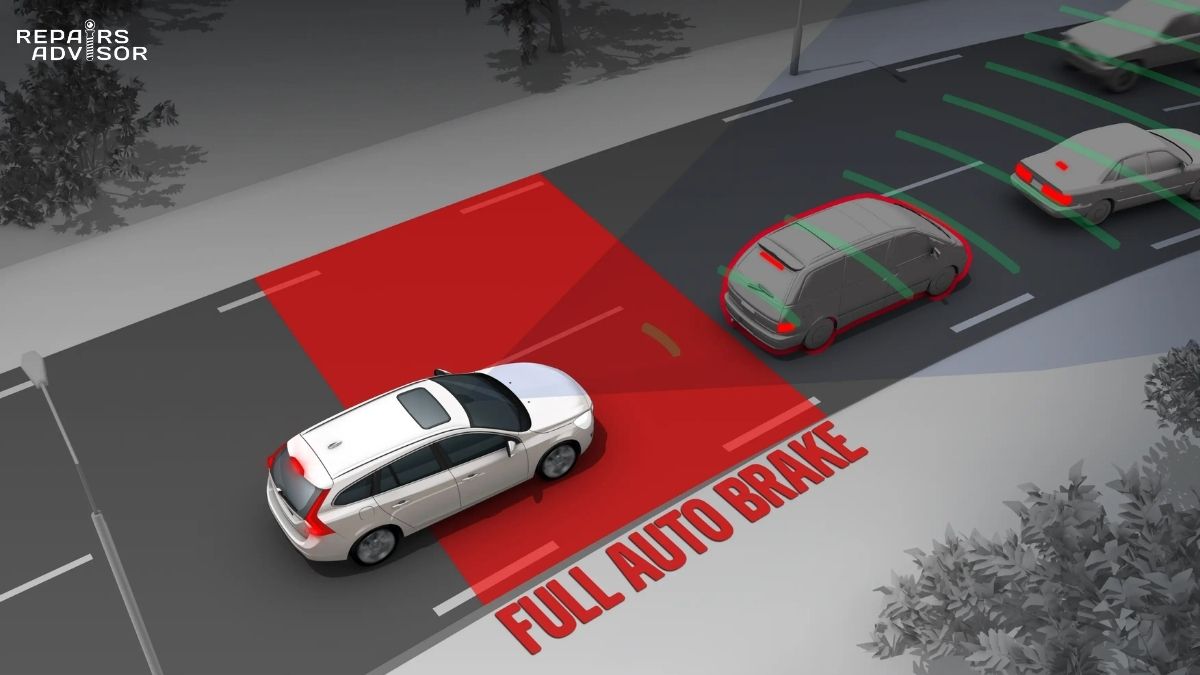
Automatic emergency braking has quietly become one of the most consequential active safety technologies in modern vehicles — fitted to roughly 90% of new cars even before it was mandated by federal regulation. Yet most drivers have only a vague sense of how it actually works: sensors of some kind, maybe a camera, something that stops the car. The reality is considerably more interesting. Understanding the sensor stack, decision logic, system variations, and real-world limitations helps drivers use AEB more confidently, recognise when something is wrong, and make sure the system is properly maintained after any repair.
Quick Answer
Automatic emergency braking (AEB) uses forward-facing radar, cameras, and sometimes lidar to continuously scan the road ahead. When the system calculates that a collision is imminent and the driver hasn’t responded in time, it automatically applies the brakes — either to avoid the impact or significantly reduce its severity. AEB reacts in fractions of a second and typically issues a visual, audible, or haptic warning before intervening. It works alongside anti-lock braking but is fundamentally different: AEB initiates braking on its own, while ABS modulates braking the driver has already applied.
What Is Automatic Emergency Braking (AEB)?
Automatic emergency braking is an active safety system — meaning it intervenes to prevent a crash, rather than protecting occupants after one has already occurred. It sits within the broader category of Advanced Driver Assistance Systems (ADAS), alongside lane departure warning, adaptive cruise control, and blind spot monitoring. The distinction from passive safety features like airbags matters: passive systems absorb energy from a crash that has happened, while AEB tries to stop the crash from occurring in the first place.
There’s a common confusion worth clearing up: AEB is not the same as ABS. ABS prevents wheels from locking up when the driver applies the brakes — it requires the driver to initiate braking. AEB initiates braking autonomously when the driver hasn’t responded to an imminent collision. The two often work together (when AEB fires, ABS modulates braking to prevent skidding), but they serve distinct functions. Similarly, AEB differs from forward collision warning (FCW): FCW detects a potential collision and alerts the driver but stops there — AEB takes the next step and applies the brakes if the driver doesn’t respond.
The technology evolved from a voluntary manufacturer commitment in 2016 to a federal mandate under NHTSA’s FMVSS No. 127, finalised in May 2024. All new U.S. light vehicles must have compliant AEB systems by September 2029, with performance thresholds more demanding than most current production systems meet.
Important: AEB is a driver-assistance tool, not a substitute for attentive driving. No current production system is designed to replace an alert driver, and every system operates within defined speed and condition windows.
The Sensor Stack — How AEB Sees the Road
No single sensor can do everything AEB needs. Detecting a vehicle at highway speed, identifying a pedestrian at night, measuring closing velocity accurately in rain — these are genuinely difficult perception tasks, and different sensor types handle them in different ways. Most production AEB combines forward-facing radar with a windshield-mounted camera; higher-end systems add lidar.
Radar
Radar is the backbone of most production AEB. Modern automotive radar operates at 77–79 GHz and excels at measuring distance, speed, and relative velocity with high precision. It works through rain, fog, and darkness — conditions that degrade camera performance significantly. The radar unit typically mounts behind the front bumper or grille. Its limitation is classification: it can detect presence and closing speed, but struggles to distinguish a pedestrian from a shopping trolley. That’s where the camera contributes.
Forward-Facing Camera
The forward-facing camera mounts inside the vehicle near the top of the windshield, typically behind the rear-view mirror. Automotive camera systems use image processing algorithms to classify objects — distinguishing vehicles, pedestrians, cyclists, and lane markings in adequate lighting. For pedestrian AEB, the camera is the critical sensor, since radar alone can’t reliably identify human silhouettes. The windshield mounting has an important practical consequence: whenever the windshield is replaced, the camera’s position shifts — a change that can meaningfully degrade AEB performance.
Lidar and Sensor Fusion
Lidar uses laser pulses to generate a precise 3D map of the environment and appears in some premium AEB systems, though it remains less common in mainstream production vehicles. The deeper reason AEB uses multiple sensor types is complementary strengths: sensor fusion algorithms combine radar, camera, and lidar data, weighting each input based on conditions. In heavy rain, radar’s all-weather reliability takes priority. On a clear day, the camera’s classification accuracy carries more weight. The fused output achieves higher confidence than any single sensor could provide.
How AEB Decides When to Intervene
The AEB control module runs a continuous calculation focused on two variables: time-to-collision (TTC) and the deceleration required to avoid impact. When TTC drops below a threshold and the driver hasn’t applied sufficient braking, the system begins its sequence.
First, threat detection: sensors identify an obstacle and calculate closing speed. If the driver’s braking is insufficient, the system issues a warning — usually a combination of audible tone, visual alert on the instrument cluster, and often a haptic signal in the seat or steering wheel. The driver has roughly 0.5 to 1.5 seconds to respond by braking or steering. If they don’t, the system commands the brakes — either partially, to extend reaction time, or fully in an imminent collision scenario.
At any point, the driver can override by pressing the brake pedal or applying steering torque, returning control immediately. Speed thresholds vary by manufacturer — some city-speed systems operate only below 30 km/h; others cover highway speeds. FMVSS 127 requires autonomous braking up to 90 mph for vehicle-to-vehicle scenarios and up to 45 mph for pedestrian detection. On most vehicles, AEB can be temporarily disabled through the settings menu, though FMVSS 127 prohibits controls designed solely for permanent AEB deactivation.
Types of Automatic Emergency Braking Systems
Several distinct AEB variants exist, each targeting a specific collision scenario. Low-speed/city AEB is designed for stop-and-go traffic and parking lots, typically operating below 55 mph. Highway-speed AEB extends protection to faster travel, where kinetic energy is dramatically higher and stopping distances are far longer — at 60 mph, a vehicle covers 88 feet per second. Pedestrian AEB relies primarily on camera inputs to classify human silhouettes; FMVSS 127 requires this to work in both daylight and darkness. Rear AEB activates in reverse, detecting cross-traffic and stationary obstacles — IIHS data shows it reduces reversing crashes by 78% compared to a rear camera alone. Intersection AEB monitors for oncoming vehicles during left-turn manoeuvres.
Many variants share sensor infrastructure with related ADAS features. Adaptive cruise control uses the same forward radar as AEB — which is why these features typically come packaged together. On hybrid and electric vehicles, AEB integrates with brake-by-wire systems rather than conventional hydraulic actuators, which changes how the braking response is executed.
AEB Limitations and False Activations
False activations — where the system brakes when no real threat exists — are the most widely reported limitation. Common triggers include dappled sunlight or strong reflections from road signs, vehicles in adjacent curved lanes that radar momentarily places in your path, overpass structures, railroad crossings, metal trench plates, and low-hanging traffic lights. NHTSA has received over 400,000 phantom braking complaints across major manufacturers, with active investigations into specific vehicle lines. This is a known characteristic of current sensor technology that manufacturers and regulators are actively working to reduce.
Environmental conditions also degrade performance. Heavy rain, dense fog, and snow or ice on sensor surfaces reduce detection accuracy. Dirt or debris blocking the radar unit or camera lens can trigger warning lights or cause the system to disable as a fail-safe. Recognition capabilities vary by system generation — not all AEB systems detect cyclists, motorcycles, or pedestrians at night. Checking your owner’s manual for your vehicle’s specific capabilities is worthwhile.
Persistent false activations causing hard unexpected braking warrant professional diagnosis. A misaligned sensor or contaminated lens can drive phantom braking — problems sensors cannot self-correct and that are closely related to the degradation lane departure warning systems experience after windshield replacement.
AEB Warning Light — What It Means and What to Do
When the AEB warning light illuminates, the system has detected a fault, been disabled by a recognised condition, or encountered a sensor obstruction it cannot resolve automatically. It signals that your collision prevention system may not be operational.
The most common causes are dirty or blocked sensors — mud, ice, or accumulated insects on the radar unit or camera lens — and sensor misalignment from even minor bodywork. Software glitches, electrical faults in wiring or connectors, and environmental conditions like towing or extreme temperatures also trigger the light, with the last group typically self-clearing when the condition resolves.
A solid AEB light indicates a permanent fault with codes stored in the control module. A blinking light signals a temporary or conditional fault that may resolve on its own. Safe first steps include inspecting the front of the vehicle for obvious debris and cleaning sensor surfaces gently, then checking whether the warning clears on restart. If it persists or recurs, a qualified technician should run a diagnostic scan — fault codes in the AEB control module will point directly to the issue.
Warning: Do not clear AEB fault codes without addressing the root cause. Clearing codes without fixing the underlying problem may leave sensors mis-aimed while giving a false impression the system is operational. AEB fault diagnosis and calibration require professional equipment.
ADAS Sensor Calibration — Why It Matters for AEB
AEB’s effectiveness depends entirely on sensors being aimed to precise factory specifications. According to IIHS Advisory 43, a camera misalignment of just 0.6 degrees is enough to cut AEB reaction time in half — a shift smaller than a pencil eraser at arm’s length, invisible to the naked eye but meaningful to a system deciding whether to apply full emergency braking within the next second.
Calibration is required in more situations than most drivers and technicians realise. Windshield replacement is the most common trigger — the forward-facing camera mounts directly to the glass, and industry research suggests nearly 9 in 10 vehicles from 2023 onward need recalibration after windshield work. Any collision or bodywork, bumper or grille repair, suspension and alignment service, tire size changes, and battery disconnection on some vehicles are additional triggers. Some manufacturers specify OEM glass only, as aftermarket windshields with different optical properties can affect camera accuracy even after recalibration.
Static calibration takes place indoors with target boards at precise distances; dynamic calibration requires driving at a set speed on well-marked roads. Many vehicles require both. The process takes 30 to 90 minutes and costs $250 to $600 for a forward camera — straightforward when weighed against a rear-end collision starting at $5,000, and typically covered by insurance when required by a covered repair.
This calibration requirement extends to the entire ADAS suite. Lane departure warning and blind spot monitoring share sensor infrastructure with the same calibration sensitivity. Industry data indicates 88% of required ADAS calibrations are missed during vehicle repairs, and roughly 25% of repair shops are equipped to perform them. If your vehicle has had any bodywork, windshield work, or suspension service, confirm with your technician that calibration was completed and documented.
Important: ADAS calibration is not a DIY task. It requires OEM-approved equipment, controlled environments, and technicians trained to verify calibration outcomes. Attempting it without proper equipment may clear fault codes while leaving sensors incorrectly aimed.
AEB and the Broader Braking System
AEB integrates into the vehicle’s complete braking architecture, sharing actuators, control modules, and data pathways with other safety systems. When AEB commands a stop, it does so through the same hydraulic actuators ABS controls, with ABS simultaneously modulating braking to prevent wheel lockup. Electronic stability control layers on top — if an AEB-initiated stop creates yaw instability, ESC applies selective individual-wheel braking to maintain directional control.
On hybrid and electric vehicles, regenerative braking blends with friction braking to produce the total deceleration force. When AEB fires on an EV or hybrid, the control logic coordinates both simultaneously — a more complex response than a conventional hydraulic-only system, managed through brake-by-wire systems that balance electric and friction braking precisely without the driver sensing the transition.
The health of the underlying brake system directly affects AEB effectiveness. A degraded brake booster, low brake fluid, or worn pads affects how efficiently the system can execute an AEB-commanded stop. Brake system condition and AEB calibration are interlinked, not separate concerns.
What to Expect From Your Vehicle’s AEB System
IIHS rates front crash prevention systems from basic through advanced to superior, based on speed reduction in standardised scenarios. Superior-rated systems initiate braking earlier and apply greater deceleration at higher speeds — differences that matter in real-world crashes. IIHS research shows AEB with forward collision warning reduces rear-end collisions by approximately 50% and rear-end injury crashes by 56%. Pedestrian AEB reduces pedestrian crashes by around 27%, with lower effectiveness at night — which is why FMVSS 127 mandates nighttime pedestrian detection.
For day-to-day driving: keep sensor areas clean, maintain adequate following distance so AEB functions as a last resort, keep the system enabled unless there’s a specific operational reason to disable it, and treat persistent AEB warning lights as requiring professional attention.
Your vehicle’s OEM repair manual contains AEB sensor locations, calibration procedures, sensitivity settings, and fault code tables — information critical for accurate diagnosis. Model-specific manuals are available for Toyota, Honda, Ford, and hundreds of other manufacturers, covering AEB architecture and recalibration requirements in the detail that accurate service demands.
Conclusion
Automatic emergency braking uses radar and cameras to apply the brakes autonomously when a collision is imminent and the driver hasn’t responded in time. IIHS data shows it reduces rear-end collisions by 50%, and NHTSA projects its forthcoming mandate will prevent 360 deaths and 24,000 injuries annually once fully deployed.
But effectiveness depends on sensors being aimed correctly, kept clean, and recalibrated whenever anything changes their position. A misalignment of less than a degree can halve reaction time. That calibration step is skipped after the vast majority of vehicle repairs, and AEB warning lights signal a compromised system — not something to dismiss. For drivers: keep sensors clean, verify calibration after any repair involving the windshield, bodywork, or suspension, and take warning lights seriously. For technicians: AEB service requires OEM-specification calibration equipment and an understanding of how AEB integrates with ABS, ESC, and — on EV and hybrid platforms — regenerative braking systems.
Automatic Emergency Braking: Frequently Asked Questions
Automatic emergency braking is now standard on the vast majority of new vehicles, yet most drivers have surprisingly few chances to understand how it actually works — until something goes wrong. These are the questions drivers, DIY enthusiasts, and technicians ask most often about AEB, answered directly.
What is automatic emergency braking and how does it work?
Automatic emergency braking (AEB) is an active safety system that monitors the road ahead using sensors — typically a combination of radar and a forward-facing camera — and applies the brakes automatically when it calculates that a collision is imminent and the driver hasn’t responded in time.
The system runs continuously while you drive, tracking distance and closing speed between your vehicle and objects ahead. When the math indicates impact is unavoidable without immediate braking, the system first issues a warning — a beep, a flashing light, or a vibration in the seat or steering wheel — giving the driver roughly 0.5 to 1.5 seconds to react. If the driver doesn’t brake or steer away, AEB applies the brakes on its own, at partial or full emergency force depending on the severity of the threat.
For a detailed breakdown of the sensor stack and decision logic, see our full guide to how automatic emergency braking works.
Is AEB the same as ABS?
No — they’re both related to braking but work very differently. ABS (anti-lock braking system) activates when the driver applies the brakes and prevents the wheels from locking up, maintaining steering control during a hard stop. ABS requires the driver to initiate braking — it modifies braking the driver has already started.
AEB initiates braking autonomously, without any driver input. If you haven’t touched the pedal and the system detects imminent impact, it commands the brakes to apply. The two systems complement each other: when AEB fires, ABS simultaneously modulates the braking to prevent wheel lockup and keep the vehicle stable through the stop.
Does AEB work at highway speeds?
It depends on your vehicle’s specific system. Low-speed (or city) AEB systems typically operate below 55 mph, designed for stop-and-go and urban traffic. Highway-speed AEB systems extend coverage to faster travel. Many modern vehicles now have full-speed AEB capable of intervening at typical highway speeds.
Even highway-speed systems have a physics limitation at very high speeds: the distances involved may not allow the vehicle to stop completely before impact. The braking intervention reduces impact speed and severity, but may not prevent the collision. The incoming NHTSA standard (FMVSS 127, mandatory from September 2029) requires AEB to apply brakes automatically at speeds up to 90 mph for lead-vehicle scenarios — a more demanding threshold than most current production systems meet.
Check your owner’s manual for the specific speed range your system covers — it varies significantly by make, model, and trim level.
Can AEB fully stop the car before an accident?
At low speeds — typically under 30 mph — most AEB systems can bring the vehicle to a complete stop and prevent the collision entirely. This is where city-speed AEB proves its value: in stop-and-go traffic and parking lot scenarios, the system has enough time and distance to execute a full stop.
At higher speeds, AEB usually reduces impact speed rather than preventing the collision entirely. Even a partial speed reduction matters significantly — crash severity is exponentially related to speed, so reducing impact velocity from 50 mph to 30 mph dramatically reduces injury risk and structural damage. AEB eliminates the accidents it can, and reduces the severity of the ones it can’t fully prevent.
Why does my AEB brake for no reason (phantom braking)?
Phantom braking — where AEB applies the brakes when no real threat exists — is a documented limitation of current sensor technology. Common triggers include dappled sunlight filtering through trees, strong reflections from wet pavement or road signs, vehicles in adjacent lanes on curves appearing in the radar’s path, and physical structures like overpass beams, railroad crossings, steel trench plates in roads, and low-hanging traffic lights.
NHTSA has logged over 400,000 phantom braking complaints across major manufacturers, with investigations leading to software updates and recalls at several brands. This isn’t necessarily a sign that your system is failing — it’s a known characteristic of the technology. But if phantom braking is severe, frequent, or creating dangerous situations (such as being rear-ended after an unexpected stop), have the vehicle professionally diagnosed. The sensors may need recalibration, or a software update may be available for your vehicle.
What does the AEB warning light mean?
The AEB warning light signals that the system has detected a fault, been disabled by a condition it recognises, or has a sensor obstruction it can’t resolve automatically. Your collision prevention system may not be operational while the light is on.
A solid, continuously lit AEB light typically indicates a permanent fault — codes are stored in the control module and the system is disabled. A blinking light usually signals an intermittent or conditional fault that may resolve on its own.
Safe first steps: check the front of the vehicle for debris, ice, or mud covering the radar unit (behind the grille or bumper fascia) or the camera area (inside the windshield near the rear-view mirror). Clean gently and see if the warning clears on restart. If it persists or recurs, a qualified technician should pull fault codes from the AEB control module to identify whether the cause is sensor misalignment, a software issue, or an electrical fault.
Important: Do not clear AEB fault codes without first diagnosing the root cause. Resetting codes without fixing the underlying problem may leave sensors mis-aimed while giving a false impression that the system is fully operational.
Why does AEB need calibration after a windshield replacement?
Because the forward-facing camera — one of AEB’s primary sensors — mounts directly to the windshield glass, typically just behind the rear-view mirror. When the windshield is replaced, the camera is removed and reinstalled, and its angular position shifts relative to the vehicle. Even a fractional degree of misalignment significantly degrades AEB performance.
According to IIHS Advisory 43, a camera misalignment of just 0.6 degrees halves AEB reaction time. The calibration process re-teaches the system where the camera is aimed relative to the vehicle’s centerline and the road ahead, using either static target boards or a dynamic road-driving procedure — sometimes both.
This requirement extends across the whole ADAS suite. Lane departure warning and blind spot monitoring share the same sensor sensitivity. Industry research indicates 88% of required ADAS calibrations are skipped during vehicle repairs — so after any windshield work, front-end bodywork, or suspension service, confirm with your technician that calibration was performed and documented.
Can I turn off AEB, and is it safe to do so?
On most current vehicles, yes — AEB can be temporarily disabled through the infotainment or driver assistance settings. Under the forthcoming FMVSS 127 standard, manufacturers will not be permitted to design vehicles with a dedicated permanent AEB disable switch. Most systems also re-enable automatically at every restart, so AEB is on by default at the beginning of each drive.
As for whether disabling it is safe: AEB is associated with a 50% reduction in rear-end collisions when active. Removing it removes that protection. In specific circumstances — towing (where a trailer may trigger false detections), off-road driving, or closed-course scenarios — temporary disabling makes sense. For everyday driving, keeping AEB enabled is the safer choice. If frequent false activations are prompting you to turn it off, that’s a calibration or software issue worth diagnosing, not a reason to permanently operate without the system.
Does AEB detect pedestrians?
Many AEB systems include pedestrian detection, but not all — and performance varies significantly, especially at night. Pedestrian AEB relies primarily on the forward-facing camera, which uses image processing to identify human silhouettes. Radar can detect the presence of an object but cannot reliably classify it as a person, which is why pedestrian detection is camera-dependent.
A study by AAA found that pedestrian detection functions inconsistently at night, with some systems working only about 60% of the time in low-light conditions — which matters because more than 75% of pedestrian fatalities occur in darkness. The NHTSA FMVSS 127 standard specifically addresses this: from 2029, new vehicles must have pedestrian AEB capable of operating in both daylight and darkness. Current system capabilities vary, so checking your owner’s manual for what your specific vehicle’s AEB can and cannot detect is worthwhile.
What’s the relationship between AEB and adaptive cruise control?
AEB and adaptive cruise control (ACC) share sensor infrastructure — both rely on the same forward radar to monitor the distance and relative speed of vehicles ahead. This shared hardware is why the two features are almost always packaged together: the radar is already there, and the control logic for following distance (ACC) and collision prevention (AEB) overlap significantly.
On hybrid and electric vehicles, both systems integrate with regenerative braking and brake-by-wire systems, coordinating electric and friction braking in real time. When AEB fires on any vehicle, electronic stability control layers on top to maintain directional control through the hard stop.
Why do manufacturers use different names for AEB?
Each manufacturer implements AEB differently and brands its version with a proprietary name. Common examples include Toyota’s Pre-Collision System (PCS), Honda’s Collision Mitigation Braking System (CMBS), Nissan’s Intelligent Emergency Braking, Subaru’s Pre-Collision Braking, Ford’s Pre-Collision Assist, Volvo’s City Safety, and Mercedes-Benz’s Active Brake Assist.
The underlying function is consistent — detect, warn, brake — but sensitivity settings, speed ranges, and detection capabilities (particularly for pedestrians and cyclists) vary considerably between implementations. When diagnosing AEB issues or looking up calibration specifications, using the manufacturer’s terminology in your vehicle’s service documentation will get you to the right technical information. Model-specific AEB sensor locations, sensitivity parameters, and calibration procedures are documented in OEM repair manuals, available for Toyota, Nissan, Honda, and hundreds of other manufacturers.
How do I keep my AEB system working properly?
AEB maintenance centres on keeping sensors clean and ensuring calibration happens when needed.
For sensor care: keep the front of the vehicle clean. The radar unit sits behind the front grille or bumper fascia and accumulates road grime, mud, and winter road salt. The forward-facing camera sits behind the windshield near the rear-view mirror — keep the windshield clean and clear of ice, and don’t obscure that area with interior accessories. Most systems will flag a warning light if sensor contamination is degrading detection accuracy.
For calibration: after any windshield replacement, front-end bodywork, bumper or grille repair, suspension or alignment service, or tire size change, confirm that AEB calibration was performed. Calibration costs $250 to $600 for a forward camera, is typically covered by insurance when required by a covered repair, and takes 30 to 90 minutes. Skipping it after a qualifying repair leaves a safety-critical system operating with potentially mis-aimed sensors.
Finally, stay current on recalls. Several manufacturers have issued AEB-related software updates and recalls — checking NHTSA’s recall database using your VIN periodically is a straightforward habit for any ADAS-equipped vehicle. For a deeper look at how the sensor fusion and hardware that AEB depends on actually works, see our complete guide to how automatic emergency braking works.