

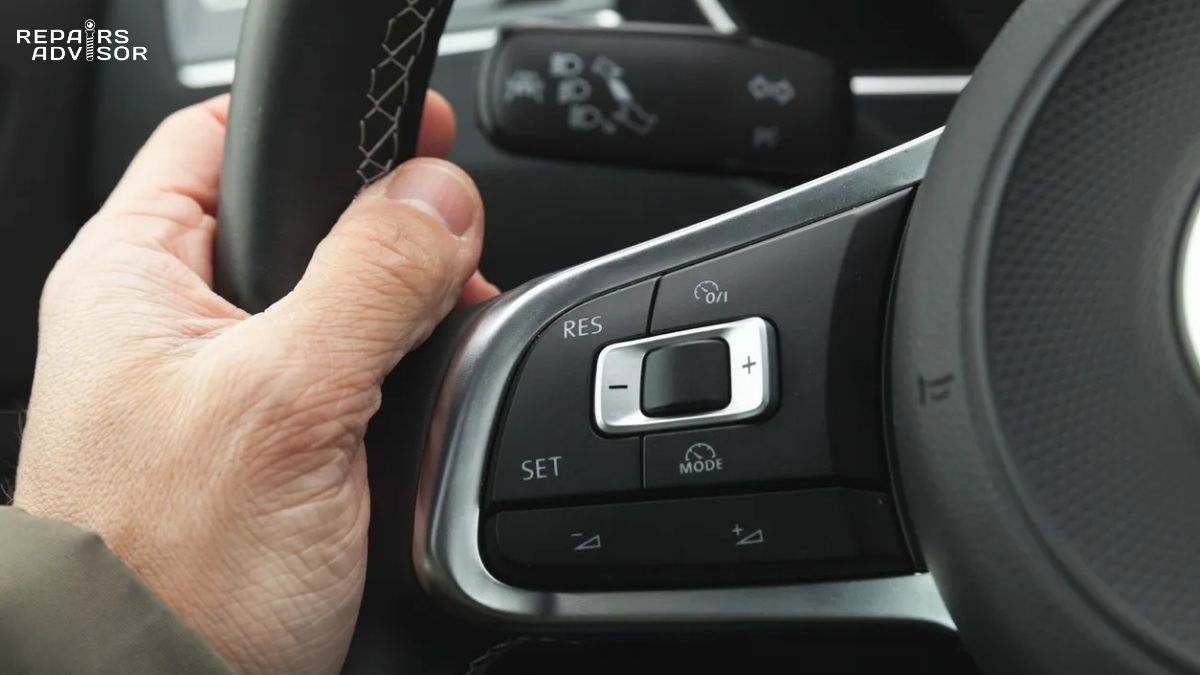
Adaptive cruise control has become one of the most widely fitted driver assistance technologies on modern vehicles, yet most drivers use it without fully understanding how it works — or why it sometimes stops working without warning. Unlike traditional cruise control, which simply holds a fixed speed until you hit the brakes, adaptive cruise control (ACC) is a complex sensor-driven system that actively monitors traffic ahead and adjusts your vehicle’s speed in real time. It can slow for a truck merging into your lane, maintain a precise following gap through shifting highway traffic, and on advanced-equipped models, bring your vehicle to a complete stop and resume driving without any driver input. Understanding how ACC operates — and where its limits lie — makes you a safer driver and a better-informed vehicle owner when something goes wrong.
Quick Answer: How Does Adaptive Cruise Control Work?
Adaptive cruise control uses forward-facing radar sensors (typically behind the front grille or bumper) and cameras (near the rearview mirror) to continuously measure the distance and relative speed of the vehicle ahead. An onboard control module processes this data thousands of times per second, automatically reducing throttle or applying the brakes to maintain your selected following gap — then accelerating back to your set speed when the road clears. Most modern ACC systems operate from highway speeds down to a full stop in traffic. The system is SAE Level 1 driver automation: it controls speed, but the driver must remain attentive and in control at all times.
Adaptive Cruise Control vs. Standard Cruise: What’s Actually Different
Standard cruise control does one thing well: it locks throttle position to hold your set speed. The moment traffic slows ahead, you cancel it and take over manually. Adaptive cruise control changes that equation entirely. The “adaptive” part means the system continuously reads the road ahead and modifies your speed to match what traffic is doing, without any driver input. If the car in front brakes, your ACC slows your vehicle. If that car moves into another lane, your ACC accelerates back to your cruising speed automatically.
This integration with the vehicle’s braking system is the core technical distinction from conventional cruise control — and it’s also why ACC faults are treated as safety-critical issues requiring professional attention. ACC is categorised under the SAE automation framework as Level 1 autonomy: it controls only longitudinal motion (acceleration and braking) while the driver remains responsible for steering, lane selection, and all situational judgement. Some systems, when paired with lane departure warning and lane-centering assistance, can qualify as Level 2, where the vehicle assists with both speed and steering simultaneously. Even at Level 2, the driver must remain engaged and ready to intervene at any moment.
Automakers market ACC under different names, but the underlying technology is broadly similar across most manufacturers. Toyota and Lexus call theirs Dynamic Radar Cruise Control (DRCC), part of Toyota Safety Sense; it uses a grille-mounted radar combined with a forward-facing camera. Honda’s system — part of Honda Sensing — is called Adaptive Cruise Control with Low-Speed Follow and relies primarily on a monocular forward camera. Subaru’s EyeSight is the notable exception: it uses stereoscopic (dual) cameras instead of radar as the primary sensor, which gives it excellent object classification but slightly reduced performance in heavy rain and fog compared to radar-based alternatives. Vehicle-specific ACC procedures for each of these platforms are covered in detail in Toyota repair manuals, Honda repair manuals, and Subaru repair manuals respectively. Mercedes-Benz introduced the first radar-based ACC — Distronic — on the S-Class in 1999; modern Distronic Plus adds stop-and-go capability and lane centering. Ford, BMW, Volkswagen, Audi, Hyundai, Kia, and virtually every mainstream manufacturer now offer systems with closely comparable hardware architectures.
How Adaptive Cruise Control Works: The Four Core Components
ACC is not a single unit. It’s an integrated system of sensors, processors, and actuators that must all function within precise tolerances. Understanding what each component does is essential context for diagnosing what’s gone wrong when the system misbehaves.
Radar Sensors: The Primary Eyes of the System
The forward-facing radar sensor is the cornerstone of most ACC systems. Modern vehicles use 77 GHz millimetre-wave radar, a significant improvement over earlier 24 GHz units that offers higher resolution and the ability to distinguish multiple targets simultaneously. The radar unit emits radio waves forward; when those waves bounce back from objects, the sensor calculates three values in continuous cycles: distance to the object, its relative speed (closing or opening), and its angular position. This data refreshes many times per second, giving the ACC control module a live picture of the road ahead out to roughly 150–200 metres at highway speeds.
Radar placement varies by manufacturer. On most vehicles the unit sits behind the front grille or bumper — sometimes hidden behind the brand emblem, sometimes behind a plain plastic panel that is radar-transparent but visually matches the surrounding grille. Some premium platforms use dual radar units for redundancy; Volkswagen Group vehicles and certain Cadillac models are examples. Understanding how 77 GHz automotive radar technology works explains why even a thin layer of dried mud or ice over the sensor location can completely disable ACC — the sensor simply cannot transmit or receive signals through significant obstruction. The radar module typically contains its own processing unit and outputs structured target data (distance, speed, bearing of each detected object) rather than raw signal streams, which means radar module faults often generate module-specific codes rather than standard OBD2 codes.
Camera Systems: The Visual Supplement
Most radar-based ACC systems pair the radar with a forward-facing camera, typically mounted at the base of the rearview mirror or within the mirror housing. The camera contributes what radar struggles with: object classification (distinguishing a vehicle from a bridge abutment or roadside sign), lane marking detection, and lateral position — information critical for determining whether the detected vehicle is actually in your lane or merely adjacent. Understanding how automotive camera systems process and interpret visual data helps explain why a stone chip or star crack in the windshield near the camera mounting zone can degrade ACC performance even when the radar is functioning normally.
Subaru’s EyeSight uses two cameras in a stereoscopic arrangement that enables depth perception through parallax — the same principle as human binocular vision. The trade-off is reduced performance in low-contrast conditions (heavy rain, fog, direct low-angle sunlight) compared to radar, which is largely weather-independent. For vehicles with camera-primary systems, windshield clarity and camera mounting condition are proportionally more critical to reliable ACC operation.
The Control Module: The Decision Brain
The ACC control module receives inputs from the radar, camera, wheel speed sensors, steering angle sensor, and yaw rate sensors, and processes this data into a continuous stream of throttle and brake commands. On modern vehicles this processing isn’t a standalone function; ACC logic is integrated into the vehicle’s broader ADAS architecture, sharing hardware and communication buses with automatic emergency braking, forward collision warning, and lane assist systems. This integration explains why a fault in the ACC radar will often disable multiple safety features simultaneously. The module applies sophisticated filtering logic to screen out false targets — gantry signs, parked vehicles at the roadside, bridge spans — while reliably tracking the lead vehicle in your lane. Sensor fusion technology cross-validates radar and camera detections: if radar picks up an object but the camera cannot classify it as a vehicle, the system adjusts its confidence weighting accordingly rather than reacting immediately.
Actuators: How the System Changes Your Speed
When the ACC module determines it needs to slow the vehicle, it works in two stages. First, throttle reduction: the ECU closes the throttle and allows engine braking to decelerate gently when a following gap is closing gradually. When that’s not enough — because the lead vehicle is braking harder — the ACC module commands brake application through the vehicle’s ABS/ESC hydraulic control unit. This is the same physical hardware used by the ABS system, controlled via electronically-operated pressure valves that modulate brake force. The driver usually feels this as normal braking, with subtle additional feedback through the brake pedal.
ACC brake authority is intentionally limited. The system is calibrated for comfort-level deceleration in foreseeable traffic scenarios — it is not a collision avoidance system. If a vehicle cuts in directly ahead at close range, or the lead driver brakes severely and suddenly, ACC may not have sufficient response time or braking authority to prevent a collision. The driver must always be prepared to brake independently. For emergency scenarios, automatic emergency braking operates as a separate, higher-priority system capable of applying significantly greater braking force than ACC alone.
Stop-and-Go ACC vs. Basic ACC: Knowing What Your System Can Do
Not all ACC systems share the same capability envelope, and confusing the two categories is a genuine safety risk.
Basic ACC — found on earlier systems and some current entry-level implementations — operates above a minimum speed threshold, typically 25–35 km/h. If traffic ahead slows below that threshold, the system disengages and requires the driver to take over manually. This type cannot be safely used in stop-and-go traffic. Always verify whether your ACC is capable of full-stop operation before relying on it in congested conditions — the owner’s manual is the definitive source, and vehicle-specific repair manuals detail the exact ACC operating parameters for each make and model.
Stop-and-Go ACC can follow traffic all the way to a complete halt, holding the vehicle stationary with the brakes applied. When traffic resumes, these systems typically require a driver input — pressing the resume button or tapping the accelerator — before moving, particularly after the vehicle has been stopped more than a few seconds. This confirmation requirement is a deliberate safety measure ensuring the driver is attentive before the vehicle pulls forward. Some systems with driver monitoring cameras can auto-resume without confirmation if the driver is determined to be watching the road.
Following distance selection also matters more than most drivers realise. Most systems offer three or four gap settings, measured in seconds of following time rather than fixed metres. At motorway speeds, a 1.5-second following gap translates to roughly 55 metres at 130 km/h — approaching the outer limit of what the ACC braking system can safely manage if the lead vehicle stops hard. Selecting medium or long gap settings provides meaningful additional reaction buffer for both the system and the driver.
What Adaptive Cruise Control Cannot Do: Limitations Every Driver Must Understand
Safety note: Adaptive cruise control is a driver assistance system, not an autonomous driving system. The driver bears full legal and practical responsibility for vehicle control at all times when ACC is engaged. The limitations below are well-documented and apply to all currently available ACC systems.
Stationary objects at speed: Most ACC radar systems are programmed to ignore stationary targets when the vehicle is travelling at highway speed. This is intentional — it prevents false braking for overhead signs and road furniture — but it means a stationary vehicle at the end of a motorway queue may not trigger ACC braking until the vehicle is dangerously close. Never rely on ACC when approaching the tail of a standing traffic queue.
Pedestrians, cyclists, and motorcycles: Basic ACC radar is designed primarily to track vehicles of comparable size and radar reflectivity to a car. Vulnerable road users may not be reliably detected, particularly at higher speeds.
Adverse weather: Heavy rain, snow, ice, or dense fog can severely impair both radar and camera performance. Most systems will display a “sensor blocked” or “ACC unavailable” warning and self-disable in these conditions — this is correct protective behaviour, not a fault. Similarly, direct low-angle sunlight can temporarily saturate the forward camera. These warning states typically self-resolve when conditions improve; they do not require workshop attention.
Winding roads and curves: The radar’s field of view is relatively narrow. On tight bends the lead vehicle can move outside this field before ACC transfers tracking, potentially causing the system to accelerate rather than maintain a gap. Manufacturers explicitly advise against using ACC on winding roads, entry and exit ramps, and areas with significant grade changes.
Phantom braking: Some drivers experience unexpected deceleration with no visible hazard ahead. This is typically caused by radar reflections from guardrails or overhead structures, or by sensor sensitivity calibration drift. Many instances are resolved by a dealer firmware update. Persistent phantom braking that doesn’t respond to a software update warrants professional sensor assessment.
Common Adaptive Cruise Control Problems: Causes and First Steps
When ACC stops working, the cause almost always falls into one of five categories. Working through them in order — from simplest and cheapest to most complex — is the correct diagnostic approach.
Sensor Obstruction: The Most Common Cause (Often Free to Resolve)
A blocked radar sensor is the single most frequent cause of an “ACC Unavailable” or “Radar Blocked” warning. The radar unit lives at the front of the vehicle where it accumulates road grime, mud, snow, ice, and insects. Even a light film of dried road spray on the bumper cover over the sensor location can be enough to trigger a fault. The forward camera is similarly susceptible to windshield contamination near its mounting point. Before doing anything else: wash the front bumper radar zone and the windshield camera area thoroughly, using soapy water on the bumper surface and glass cleaner on the windshield. With most systems, ACC will self-recover within a few minutes of normal driving after the obstruction is removed.
Sensor Misalignment: Requires Professional Calibration
Radar and camera sensors are mounted with extremely tight angular tolerances — fractions of a degree. A misalignment of just one degree shifts the sensor’s detection path by several metres at highway speed, meaning the system may miss the vehicle directly ahead or detect phantom targets in adjacent lanes. Causes include minor impacts (a parking lot nudge, hitting a kerb hard), bumper removal during bodywork, windshield replacement, wheel alignment work, and suspension component replacement — any repair that changes front-end geometry or disturbs sensor mounting positions.
When ACC behaves erratically — phantom braking, inconsistent following distance, or failure to engage after a repair — misalignment is the likely explanation. Resolution requires professional ADAS calibration using OEM-approved target equipment and brand-specific software. Static calibration positions the vehicle precisely in front of calibration targets in a controlled workshop environment; dynamic calibration involves driving the vehicle under specified conditions while the system recalibrates through live data. Some vehicles require both. This calibration process draws on the same precision ADAS infrastructure used by ESC and other safety systems — it cannot be replicated with general-purpose tools, and attempting to do so risks creating a system that appears operational but is working from incorrect sensor data.
Software and Module Faults
Like any embedded computer, the ACC module can experience software glitches that cause erratic behaviour without any underlying hardware fault. The first step is always a full system restart: switch the engine off, open the driver’s door (this clears residual power from most modules), wait 60 seconds, then restart. This resolves a surprising number of intermittent ACC faults. If the fault persists, check whether the manufacturer has issued a Technical Service Bulletin (TSB) or firmware update for your vehicle — phantom braking complaints have prompted software updates across multiple brands. TSB updates for ADAS systems are typically dealer-only procedures. An OBD2 scanner can retrieve fault codes from the ACC module, but manufacturer-specific extended codes that describe ACC faults in detail require brand-specific diagnostic software to interpret meaningfully. Understanding how ADAS-integrated sensors report faults through the vehicle network clarifies why a standard code reader often returns nothing actionable even when ACC is clearly malfunctioning.
Post-Repair Calibration Failures
This category is frequently overlooked — and it’s worth emphasising. Any repair involving the front-end structure, windshield, bumper, or suspension geometry has a significant probability of affecting ACC sensor alignment. The mandatory calibration list includes: windshield replacement (many manufacturers require OEM glass with specific camera attachment provisions), front bumper removal or replacement, any collision repair near radar locations, wheel alignment, suspension component replacement, and any work involving removal and reinstallation of the radar or camera units themselves. Even painting over a bumper section near the radar can affect signal transmission if the resulting paint thickness is excessive.
Insurance and bodywork repairs are a common scenario where calibration is skipped, leaving the driver with repaired physical damage but an ADAS system now operating from miscalibrated sensor data. If your vehicle has had bodywork and ACC wasn’t explicitly included in the repair scope, request written confirmation that calibration was performed — or have it independently verified by an ADAS-equipped workshop. It’s also worth knowing that a fault in ACC sensors typically disables related systems: blind spot monitoring, forward collision warning, and automatic emergency braking often share the same hardware and will disable together when the common sensor is compromised.
Electrical and Wiring Faults
The ACC radar and camera have dedicated wiring runs from the front of the vehicle through to the main electrical architecture, exposed to moisture, road salt, heat cycling, vibration, and — occasionally — rodent damage. Connector corrosion at the sensor plug and chafed wiring harnesses are legitimate failure modes on older vehicles or those in salted-road environments. Low 12V battery voltage (below approximately 12.4V at rest) can also trigger sporadic ADAS faults, as control modules receiving insufficient voltage generate unpredictable behaviour. Battery condition should be checked early in any ADAS fault diagnostic sequence. Front-mounted proximity sensors share the same front-end wiring zones as ACC radar, so a wiring inspection in this area covers multiple systems.
Diagnosing ACC Problems: What You Can Check and When to Call a Professional
There is a clear line between what an informed owner can investigate and what requires professional ADAS diagnostic equipment. Respecting that line protects both your vehicle and the safety of other road users.
Safe DIY Checks for All Skill Levels
Work through these steps before spending any money. Clean all sensor surfaces — the front bumper radar zone and the windshield camera area — using soapy water on the bumper and glass cleaner on the windshield. Perform a full system restart (engine off, door open, 60-second wait, restart). Check your owner’s manual for any ACC-specific reset procedure; some systems include a manual re-orientation mode that involves driving at a specified speed on a clear straight road. Check fuses: the owner’s manual lists locations for cruise control, radar, and camera circuits. Check 12V battery voltage with a multimeter if available — address any battery fault before further diagnosis. Finally, connect an OBD2 scanner to retrieve any stored fault codes and note them; search for TSBs applicable to your vehicle and those specific codes before drawing conclusions.
When Professional Assessment Is Required
If cleaning, restarting, and a basic electrical check don’t clear the fault — or if ACC stopped working after any bodywork, windshield replacement, or suspension repair — professional diagnosis is the next step. A qualified workshop with brand-compatible ADAS diagnostic equipment can read the full extended fault code set from all relevant modules, perform a physical sensor aim check, and determine whether calibration, sensor replacement, or a software update is needed. Diagnostic labour typically runs to approximately one hour. For reference: front radar sensor replacement (parts only) generally falls in the $900–$1,300 range depending on the vehicle; camera sensor replacement runs $850–$1,900; professional ADAS calibration without parts replacement typically costs $150–$400 depending on whether static, dynamic, or both procedures are required. A professional diagnosis to identify the fault before committing to parts is money well spent — ACC components are expensive to replace unnecessarily.
Parking assist systems share calibration requirements with ACC on many vehicles, so a combined ADAS inspection during the same workshop visit is often the most cost-effective approach.
How ACC Connects to the Broader ADAS System
Adaptive cruise control rarely operates in isolation within the vehicle’s electronics. On most modern platforms, ACC shares sensors, control modules, and communication pathways with a suite of related systems — and this interconnection shapes both how faults manifest and how they should be diagnosed.
Forward Collision Warning and Automatic Emergency Braking use the same front-facing radar and camera hardware as ACC. When the radar module fails or becomes miscalibrated, all three systems typically disable together, generating multiple concurrent dashboard warnings. This is a deliberate safety design: rather than allowing a degraded sensor to continue feeding data to safety-critical functions, the vehicle shuts them all down and alerts the driver to take full manual control. Electronic Stability Control integrates with ACC through shared yaw rate sensors and wheel speed data, which ACC uses to adjust its following distance calculations based on vehicle dynamics. The steering angle sensor provides path prediction data that helps ACC determine how to adjust the following target as the road curves — a fault or uncalibrated steering angle sensor can cause inconsistent ACC behaviour on bends even when the radar and camera are functioning correctly.
This systems integration means ACC diagnosis should always start with reading fault codes across all ADAS-related modules simultaneously, not just the ACC module in isolation. A fault that appears to originate in ACC may actually be rooted in a shared sensor or communication bus fault that only becomes clear when the full system picture is visible.
Using Adaptive Cruise Control Safely
When used within its design parameters, ACC is a genuinely effective tool for reducing driver fatigue on long highway journeys and navigating stop-and-go commutes. Research has found that vehicles equipped with ACC and automatic emergency braking show meaningfully reduced rear-end collision rates compared to vehicles without these systems. But those benefits depend on the driver understanding the system’s capabilities and its limits — and treating it as an assistant, not a replacement for attention.
Use ACC on appropriate roads: limited-access highways and dual carriageways where traffic flows predictably, lanes are clearly marked, and sharp curves are minimal. Avoid using it in heavy rain or snow, on winding country roads, in urban environments with frequent junctions, or when towing unless your owner’s manual explicitly confirms ACC is tow-compatible. Keep sensor areas clean as part of normal vehicle maintenance — a quick check of the front bumper radar zone whenever you wash the vehicle adds negligible time but significantly reduces unexpected fault events. After any relevant bodywork or windshield replacement, confirm in writing with the repairing shop that ADAS calibration was completed.
For vehicle-specific information on your ACC system’s exact capabilities, operating parameters, and calibration requirements, the manufacturer’s service documentation is the authoritative reference. Browse car repair manuals to find the correct service documentation for your make, model, and year — ACC procedures and specifications vary significantly between manufacturers and even between model generations of the same vehicle.
Adaptive Cruise Control FAQ: Your Questions Answered
Adaptive cruise control generates more driver questions than almost any other modern vehicle feature — partly because the technology varies significantly between makes and models, and partly because it behaves differently from what most drivers expect. This FAQ covers the questions that come up most often: fuel economy, towing, retrofitting, weather performance, and what to do when the system misbehaves. For a full technical explanation of how ACC works and how to diagnose faults, see our complete guide to how adaptive cruise control works.
Quick Answer
Adaptive cruise control uses radar sensors and a forward-facing camera to maintain a set following distance automatically, adjusting speed without driver input. It performs best in dry, clear highway conditions. It requires professional ADAS calibration after any repair affecting sensor alignment — including windshield replacement and bumper work. It is not a self-driving system: driver attention and readiness to intervene are mandatory at all times.
Does Adaptive Cruise Control Save Fuel?
On flat highways with steady traffic, ACC can match or slightly improve on most drivers’ manual fuel economy. The system holds a more consistent speed than most people do by hand, eliminating the subtle speed fluctuations that waste fuel. A study conducted by Volvo and the National Renewable Energy Laboratory estimated ACC fuel savings of around 5–7% on open highways compared to manual driving.
The picture is less straightforward in denser traffic. Research published in Nature Communications (Argonne National Laboratory, 2024) found that while ACC delivers efficiency gains when moderating harsh acceleration and braking events, at the overall trip level it often results in a slight increase in fuel consumption. In cruising mode, ACC tends to respond to minor speed variations in the vehicle ahead more promptly than a human driver would, using more fuel than simply coasting through small gaps.
In practice, ACC is unlikely to meaningfully hurt your fuel economy on a highway run and may help on routes with variable traffic. It won’t match the efficiency of a skilled, anticipatory human driver, but it’s a reasonable trade-off for reduced fatigue on long journeys. For a full overview of how driving behaviour affects efficiency, see our guide to what MPG means and how it’s calculated.
Can I Use Adaptive Cruise Control While Towing?
This depends entirely on your specific vehicle — and the correct source is always your owner’s manual, not general advice.
Some vehicles explicitly support ACC while towing. Certain Ford Super Duty trucks, Chevy Silverado and GMC Sierra models with integrated trailer brake controllers, and other tow-focused platforms are engineered so that ACC accounts for the additional weight and braking demands of a trailer. These systems typically require the trailer to be electrically connected and within the vehicle’s approved towing weight limits.
Many other vehicles — particularly passenger cars and non-tow-focused SUVs — either prohibit ACC use while towing in the owner’s manual, or were not designed with towing dynamics in mind. On these platforms, risks include: the ACC braking system may be insufficient to slow the combined vehicle-and-trailer mass at the following gap it’s calibrated for; unexpected deceleration events (phantom braking, a vehicle cutting in) are more dangerous with trailer momentum behind you; and some systems will automatically disable ACC when they detect a trailer is connected.
Always check the owner’s manual before using ACC with any trailer. If towing capability is a factor in your vehicle purchase, truck repair manuals cover towing-specific ACC configurations and limitations for major truck platforms.
Can Adaptive Cruise Control Be Added to My Car Aftermarket?
Technically yes in specific circumstances — but for most vehicles the honest answer is “not cost-effectively, and not without significant technical complexity.”
The most realistic retrofit scenario is a vehicle that was manufactured with ACC as an optional feature but wasn’t ordered with it. On these platforms the underlying wiring harness, sensor mounting provisions, and software may already be partially in place. Sourcing OEM radar and camera modules and using brand-specific coding tools (FORScan for Ford, VCDS for Volkswagen Group, AlfaOBD for Stellantis) to activate the system can work — enthusiast communities for Ford Transit, Jeep Gladiator, and VW Group vehicles have documented these retrofits in some detail. Parts costs typically run $800–$1,500, plus professional ADAS calibration.
For vehicles not designed with ACC in any trim, a true OEM-equivalent retrofit is generally not feasible within a reasonable budget. Universal aftermarket cruise control kits exist, but these typically control only the throttle — they don’t apply brakes, which means they cannot provide following-distance management or stop-and-go capability. That’s basic speed-hold cruise, not adaptive cruise control. Some higher-end aftermarket systems add limited radar sensing with throttle-only control, but rarely integrate cleanly with the vehicle’s ABS and stability systems.
If ACC matters to you, the most reliable path is a vehicle built with it from the factory. For model-specific retrofit feasibility, dedicated owner forums are the most useful resource — documentation varies substantially by make and year.
How Do I Know If My Car Has Adaptive or Standard Cruise Control?
The quickest check is the steering wheel button layout. Standard cruise control shows a single speedometer icon. Adaptive cruise control adds a small car symbol in front of the speedometer. Look also for a separate gap or following-distance button — it typically shows a car with distance bars in front — which is exclusive to ACC systems and lets you cycle between short, medium, and long following gaps.
If you’re unsure after looking at the controls, check the instrument cluster when the system is active. ACC typically displays a two-car icon on the driver information screen, showing your vehicle and the vehicle ahead, often with a gap indicator. Standard cruise shows only a speed indicator. The owner’s manual is the definitive answer — search for “adaptive cruise” or “following distance” in the index, or look for radar or camera references in the cruise control section.
Is It Safe to Use Adaptive Cruise Control in Rain or Snow?
Use caution in light rain; avoid ACC in moderate to heavy rain, snow, ice, or dense fog.
In light rain, radar-based ACC systems are generally unaffected — 77 GHz radar penetrates light rain well. The forward camera may see minor degradation, but the more significant concern is the road surface. Wet roads reduce available traction, meaning ACC’s calibrated following distance and braking response — designed for dry conditions — may be insufficient for stopping safely. ACC has no way to detect reduced grip or adjust for it.
Snow accumulation over the front bumper radar zone is a common trigger for “ACC Unavailable” warnings in winter conditions. This is correct protective behaviour, not a fault — the system shuts down when sensor visibility is compromised rather than operating on degraded data. Ice over the radar location does the same. If ACC disables itself in snowy or icy conditions, treat it as the system working as designed.
In fog, camera performance degrades significantly. Radar handles fog better than cameras, but in dense fog, detection range may be insufficient. Combined with the general unpredictability of low-visibility conditions and reduced stopping distances, fog calls for full manual control and conservative following distances that ACC cannot calculate automatically.
The principle is straightforward: ACC was designed for clear, dry highway conditions. Any condition that reduces traction or sensor visibility narrows the safety margin between what the system calculates and what’s actually needed to stop safely.
Why Does My Adaptive Cruise Control Keep Turning Off?
Repeated unexpected disengagement has several distinct causes — work through them from simplest to most complex.
Dirty sensors. The most common cause by far. A film of road grime on the radar unit (front bumper or grille area) or the forward camera (windshield near the rearview mirror) can cause intermittent tracking loss. Clean both with soapy water on the bumper and glass cleaner on the windshield, then test. This resolves a large proportion of repeated disengagement complaints without any further work.
Speed below the system’s minimum threshold. Basic ACC systems disengage below around 25–35 km/h. If traffic slows to below this threshold, the system disengaging is normal and expected — it’s not a fault. Stop-and-Go equipped systems handle low speed and stopped traffic without disengaging.
Sensor misalignment. A slightly misaligned radar loses reliable lead-vehicle tracking more easily. This is a common explanation for ACC that worked reliably until a recent low-speed impact, pothole strike, or front-end repair. Professional ADAS calibration is required — see our article on how automotive radar sensors work for context on why alignment tolerances are so tight.
Software or module fault. Control module glitches can cause erratic disengagement without any sensor issue. A full restart (engine off, driver door open, 60-second wait, restart) clears transient software states and resolves many intermittent cases. If the fault persists, check for relevant Technical Service Bulletins — repeated disengagement has been addressed by firmware updates on several platforms.
Cascading ADAS fault. Because ACC shares sensors and control hardware with automatic emergency braking and forward collision warning, a fault in any of those systems can disable ACC. An OBD2 scan may reveal codes in the ADAS module cluster even if the specific ACC code isn’t set. Understanding how AEB and ACC share hardware explains why multiple warning lights often appear together.
Does Adaptive Cruise Control Work at All Speeds?
This depends on your specific system, and it’s worth verifying before you rely on ACC in slow traffic.
Limited Speed Range ACC operates above a minimum threshold — typically 25–35 km/h — and disengages when traffic slows below that point. The driver must brake and resume manually. This type is designed for highway use and is not suitable for stop-and-go conditions.
Full Speed Range ACC (Stop-and-Go ACC, Traffic Jam Assist) can follow traffic from highway speed all the way to a complete stop. Resume behaviour after a full stop varies by vehicle: some systems auto-resume when the vehicle ahead moves (within a few seconds), others require a driver confirmation — pressing resume or tapping the accelerator — before the vehicle will pull away. Understanding how ABS integrates with ACC explains why full stop-and-go capability requires deeper braking system integration than basic speed-hold cruise.
To check which type you have: look for “stop-and-go,” “low-speed follow,” or “full speed range” in the owner’s manual cruise control section. If your system has a listed minimum operating speed, it’s Limited Speed Range. If no minimum speed is listed and the system name includes “traffic jam” or “stop-and-go,” it’s almost certainly Full Speed Range.
Will Using ACC Wear Out My Brakes or Tyres Faster?
Under normal highway use, no — ACC applies brakes gently and progressively, which is easier on brake components than repetitive sharp manual braking. On long highway runs, the reduction in unnecessary braking events may marginally reduce pad and rotor wear compared to typical manual driving habits. Tyre wear is similarly unaffected; the system doesn’t generate lateral forces that accelerate tyre wear.
The exception is phantom braking. If your ACC is generating uninstructed braking events — braking sharply for no visible reason — those create unnecessary heat cycles and uneven pad loading. A system with persistent phantom braking should be professionally assessed both for safety and to prevent cumulative wear from repeated hard stops. See our guide on how often to replace brake pads for wear indicators to monitor regardless of whether ACC is in regular use.
For vehicle-specific service documentation covering your make and model’s ADAS and braking systems, browse car repair manuals to find the correct procedures for your vehicle.