

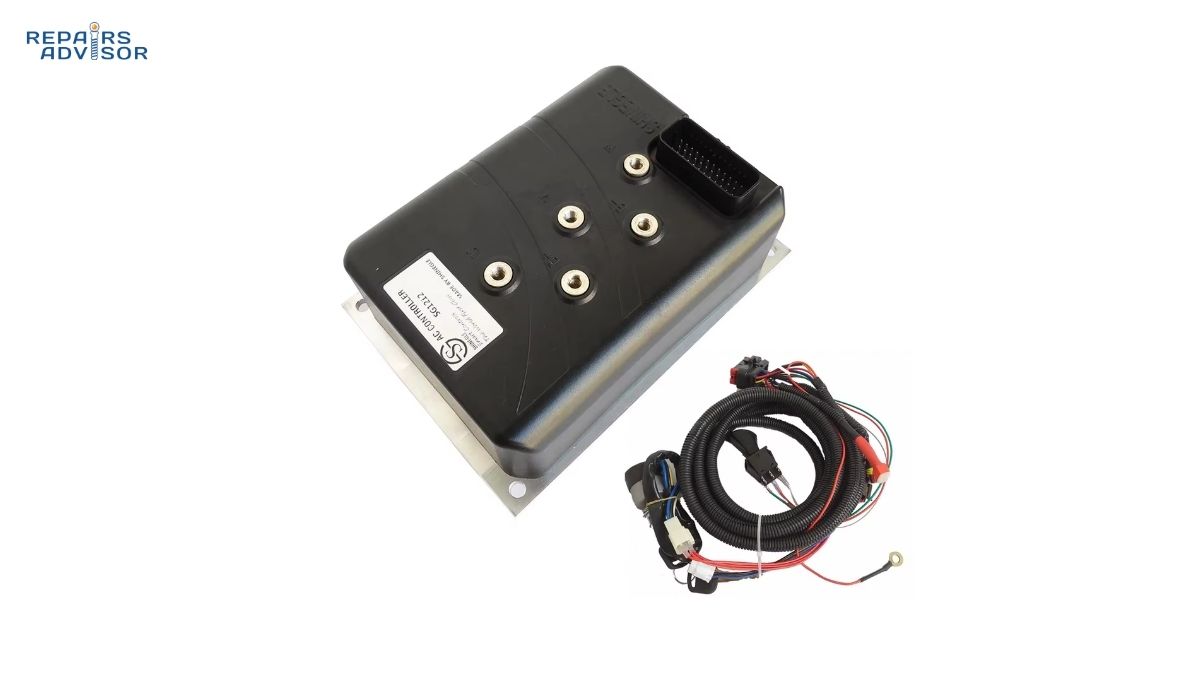
Every electric and hybrid vehicle on the road today depends on a single component to translate battery energy into wheel torque: the electric motor controller. This power electronics unit sits between the high-voltage battery pack and the traction motor, converting stored DC energy into precisely timed AC waveforms that spin the motor at the exact speed and torque the driver demands. When the controller fails or degrades, the vehicle loses propulsion control — partial power, limp mode, or a complete shutdown.
Quick Answer
An electric motor controller is the power electronics module that converts DC voltage from the battery pack into AC current to drive the traction motor. It uses IGBT or SiC MOSFET switching devices operating at 5,000–20,000 Hz to regulate motor speed and torque in real time. The controller also manages regenerative braking, thermal protection, and fault isolation — operating at voltages between 200–800V DC depending on the platform.
What an Electric Motor Controller Does
Think of the motor controller as a translator between two systems that speak different electrical languages. The battery pack stores energy as direct current at a fixed voltage. The traction motor needs alternating current at variable frequency and amplitude to produce usable torque. The controller bridges that gap — it takes DC in and outputs a three-phase AC waveform shaped to match exactly what the motor needs at any given instant.
This is not a simple on/off switch. The controller continuously adjusts output frequency to control motor speed, modulates voltage amplitude to control torque, and reverses power flow direction during braking to recover energy. It processes commands from the vehicle’s electronic control units via CAN bus — throttle position, brake pressure, traction control requests — and executes them within milliseconds.
Without the controller, the battery could only dump raw DC power into the motor with no regulation. No speed control, no torque management, no regenerative braking, no fault protection. The controller is what makes an electric drivetrain drivable.
Core Components Inside the Controller
Power Switching Devices
The heart of any motor controller is its power semiconductor module. Most production EVs use Insulated Gate Bipolar Transistors (IGBTs) arranged in a three-phase bridge configuration — six switches total, two per phase. Each switch toggles on and off thousands of times per second, chopping the DC bus voltage into pulse-width-modulated segments that reconstruct an AC sine wave at the motor terminals.
Newer platforms — including the Tesla Model 3, Hyundai Ioniq 5, and BYD Seal — are shifting to Silicon Carbide (SiC) MOSFETs. SiC devices switch faster with lower losses, which translates directly into better range. A SiC inverter can reduce switching losses by 50–75% compared to silicon IGBTs, and the higher switching frequency produces a cleaner AC waveform with less motor noise.
DC Bus Capacitor and Gate Drivers
The DC bus capacitor sits across the high-voltage input and smooths voltage ripple caused by rapid switching. Film capacitors rated at 400–900V are standard — the same high-voltage bus that supplies the DC-DC converter for the vehicle’s 12V systems. If this capacitor degrades, the DC bus develops voltage spikes that can damage the switching devices and trigger overcurrent shutdown.
Gate driver circuits provide the precisely timed voltage pulses that turn each IGBT or MOSFET on and off. Gate timing accuracy is critical — if two switches in the same phase leg turn on simultaneously (a shoot-through fault), the DC bus shorts and the module can be destroyed in microseconds. Gate drivers include dead-time protection to prevent this.
Current Sensors and Position Feedback
Hall-effect current sensors measure phase current in real time, feeding data to the control algorithm that adjusts switching patterns. A rotor position sensor — typically a resolver or encoder — tells the controller exactly where the motor’s magnetic field is oriented. Without accurate position data, the controller cannot synchronize its output waveform with the rotor, and the result is torque ripple, efficiency loss, or stall.
How Power Conversion Works — DC to AC
The conversion process relies on Pulse Width Modulation (PWM). Instead of generating a smooth sine wave directly, the controller rapidly switches the DC bus voltage on and off at frequencies between 5 kHz and 20 kHz. By varying the duration of each pulse — the duty cycle — the controller synthesizes an effective AC waveform that the motor’s inductance smooths into usable current.
Most modern controllers use Field-Oriented Control (FOC), also called vector control. FOC decomposes motor current into two components: one that produces torque (q-axis current) and one that manages the magnetic field (d-axis current). By controlling these independently, FOC delivers precise torque response across the full speed range — from zero RPM at launch to maximum RPM on the highway. This is why EVs produce instant torque from a standstill.
The controller adjusts output frequency to control motor speed. At 60 mph in a typical EV, the motor might spin at 8,000–10,000 RPM through a fixed-ratio reduction gearbox. The controller’s output frequency at that speed — around 400–600 Hz for a common 6-pole motor — is far above the 50/60 Hz of household AC power.
Controller Types by Motor Architecture
Different motor designs require different control strategies. The controller must match the motor’s electromagnetic characteristics — a mismatch means poor efficiency, excessive heat, or outright failure to operate.
| Motor Type | Control Method | Key Characteristics | Common Applications |
|---|---|---|---|
| AC Induction | FOC or V/f control | No permanent magnets; rotor current induced by stator field. Robust, lower cost, slightly lower efficiency at partial load. | Tesla Model S/X (front motor), some commercial EVs |
| PMSM (Permanent Magnet Synchronous) | FOC with position sensor | Permanent magnets on rotor; highest efficiency at rated load. Requires precise rotor position feedback. Sensitive to demagnetization above 150°C. | Most production EVs and hybrids (Toyota, Hyundai, BMW, Tesla rear motor) |
| BLDC (Brushless DC) | Trapezoidal commutation or FOC | Similar to PMSM but with trapezoidal back-EMF. Simpler control logic, more torque ripple. Lower cost for smaller applications. | E-bikes, golf carts, auxiliary motors (HVAC blowers, coolant pumps) |
PMSM controllers dominate the automotive EV market because permanent magnet motors deliver the best power density and efficiency for traction applications. The controller’s FOC algorithm is calibrated specifically to the motor’s flux linkage, resistance, and inductance values — parameters that vary by manufacturer and model. This is why a motor controller from one vehicle platform cannot simply be swapped into another.
Regenerative Braking Control
When the driver lifts off the accelerator or applies the brake pedal, the motor controller reverses the power flow. Instead of driving the motor, the controller reconfigures the traction motor as a generator — the motor’s rotation produces AC current that the controller rectifies back to DC and routes into the battery pack for storage.
The amount of regenerative braking force depends on the controller’s current limit and the battery’s state of charge. If the battery is nearly full, it cannot accept significant regen current — the controller must reduce regenerative torque and rely on friction brakes to slow the vehicle. Modern systems blend regen and friction braking seamlessly, with the controller coordinating torque requests through the vehicle network.
Regenerative braking typically recovers 10–25% of kinetic energy during city driving, depending on driving style and terrain. Aggressive one-pedal driving modes maximize regen by applying strong deceleration as soon as the accelerator is released — the controller ramps regenerative torque to its maximum limit, often producing 0.2–0.3g of deceleration without touching the brake pedal.
Fault Protection and Safety Systems
The motor controller monitors its own health continuously. If operating parameters exceed safe limits, the controller takes protective action — from derating output power to cutting propulsion entirely.
Overcurrent protection triggers when phase current exceeds the IGBT/MOSFET safe operating area. The controller shuts down switching within microseconds to prevent device destruction. Overvoltage protection activates if the DC bus voltage spikes during regenerative braking — especially when the battery management system suddenly limits charge acceptance. Overtemperature protection derates power output as the controller’s coolant temperature rises past its threshold, typically around 65–80°C at the coolant inlet.
The controller integrates with the vehicle’s high-voltage interlock loop (HVIL) system. If any HV connector is opened — during a crash, during service, or due to a wiring fault — the high-voltage contactors open and the controller ceases operation immediately. This is a non-negotiable safety requirement: the controller must not attempt to drive the motor when HV isolation is compromised.
Thermal management is equally critical. Controllers in modern EVs share a dedicated cooling loop with the battery thermal management system or run an independent coolant circuit. IGBT junction temperatures can exceed 150°C during sustained high-power operation — without liquid cooling, the power semiconductors would derate within seconds. In e-axle designs where the controller, motor, and gearbox share a single housing and cooling circuit, thermal budgets tighten further.
Signs of Controller Failure
Motor controller failures typically announce themselves before total shutdown. Reduced power or unexpected derating — the vehicle feels sluggish and the dashboard displays a power-limit warning — often indicates overtemperature or a degraded power device. Intermittent torque loss or jerky acceleration suggests a failing current sensor or gate driver issue disrupting the FOC algorithm.
A “Check EV System” or “Power System Malfunction” warning on the instrument cluster is a common symptom. The controller logs diagnostic trouble codes to the vehicle’s onboard network — codes related to inverter temperature, phase current imbalance, DC bus voltage faults, or resolver signal loss. A scan tool capable of reading EV-specific modules (not just generic OBD-II) is required to retrieve these codes.
Controller replacement is not a DIY job. The unit operates at lethal voltages — 200–800V DC with energy stored in the DC bus capacitor that persists after the vehicle is powered down. OEM service procedures require technicians to follow high-voltage de-energization and lockout/tagout protocols, verify zero voltage with a CAT III rated meter, and wear Class 0 insulating gloves before touching any HV component. A replacement controller typically runs $2,000–$5,000+ for the module alone, with labor adding $500–$1,500 depending on integration complexity.
Conclusion
If your EV or hybrid displays power-limit warnings or intermittent torque loss, have the controller DTCs read with an EV-capable scan tool before authorizing a replacement. Many symptoms that mimic controller failure — voltage sag, thermal derating, CAN communication faults — originate in the battery pack, cooling system, or wiring harness rather than the controller itself. Isolate the root cause before committing to a $2,500–$6,500 controller replacement.
High-voltage system work requires ASE-certified EV technicians with proper insulation equipment. Do not attempt to open, test, or bypass the motor controller without following the manufacturer’s high-voltage de-energization procedure — the DC bus capacitors inside the unit can hold a lethal charge for minutes after the vehicle is shut down.