

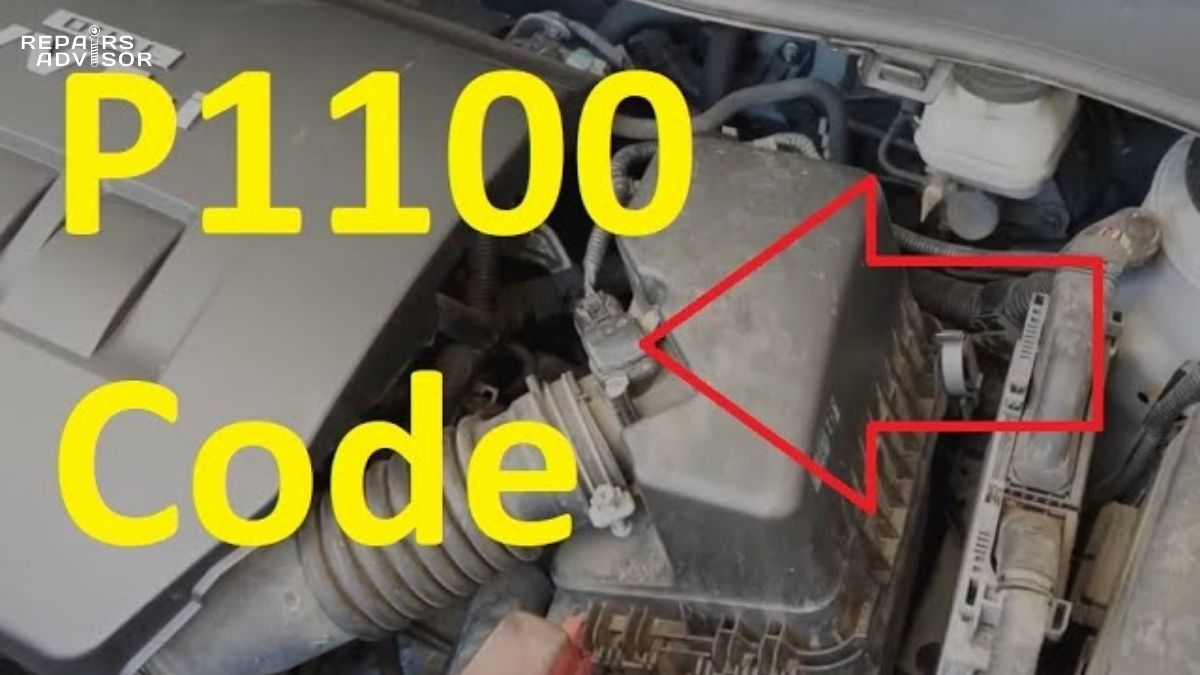
If a scan tool just pulled a P1100 code, the powertrain control module (PCM) detected the mass airflow (MAF) sensor’s voltage signal briefly spiking or dropping outside its calibrated limits — then returning to normal. That “briefly” is the key word. This is an intermittent fault, not a constant one, which is exactly what makes it trickier to chase down than a sensor that’s simply broken.
Quick answer: P1100 means the PCM caught the MAF sensor signal cutting in and out — outside calibrated limits for a moment, then back to normal. The most common cause is a loose, corroded, or moisture-affected connector rather than the sensor itself. Cleaning the MAF sensor and inspecting the connector are the cheap, low-risk first steps to try before assuming you need a new sensor.
What Does the P1100 Code Mean?
P1100 is a manufacturer-specific code, most commonly seen on Ford vehicles, defined as “MAF Circuit Intermittent Voltage Input.” The PCM briefly loses a trustworthy airflow reading from the MAF sensor, then the signal returns to normal — which is why it can be harder to catch on a single test than a fault that’s present all the time.
It helps to distinguish this from its close relative, P1101 (out of self-test range). P1101 describes a sustained reading that fails the PCM’s self-test comparison against throttle position and manifold pressure data. P1100 is different: it’s about the signal cutting in and out, which points diagnostic attention toward connections and wiring rather than a sensor that’s simply reading wrong all the time.
That distinction matters for where you start looking. A sustained fault like P1101 tends to point toward the sensor element itself or a persistent air leak, since the reading is wrong every time it’s checked. An intermittent fault like P1100, by contrast, often clears completely during a static test and only reappears once the vehicle is back in motion — which is why connector and wiring issues, not sensor failure, account for the majority of P1100 cases.
Common Symptoms of a P1100 Code
- Occasional stalling
- Hesitation under load
- Rough or hiccuping idle
- Reduced fuel efficiency
- Occasional hard starting
The key pattern with P1100 is that symptoms often come and go rather than being constant — a hallmark of an intermittent electrical fault rather than a straightforward component failure. If you clear the code, keep in mind that resetting the check engine light doesn’t fix an intermittent connection — the code will likely return once the fault reproduces itself again.
What Triggers a P1100 Code? Common Causes
Dirty or Partially Failed MAF Sensor
Contamination on the sensing element doesn’t always cause a constantly wrong reading — sometimes it produces an inconsistent one that only misbehaves under certain airflow conditions or temperatures.
Loose, Corroded, or Moisture-Affected Connector
This is the most frequently cited cause of P1100 specifically. Bent or pushed-out pins, corrosion on the terminals, or moisture that’s worked its way into the connector housing can all create a connection that works most of the time but drops out intermittently.
Chafed or Damaged Wiring Harness
A wire that’s rubbing against a bracket or another component can produce a fault that only shows up under vibration or specific engine movement — which is part of why this code can be so hard to reproduce on a stationary vehicle. Understanding how wiring harnesses work and how wiring harnesses and grounding work together helps make sense of why a fault might only appear when the engine is under load or the vehicle hits a bump.
Weak or Intermittent Ground Connection
A marginal ground connection can behave the same way as a signal-wire fault — working fine most of the time, then dropping voltage briefly under the wrong conditions. Reviewing how ground systems work is useful background here, since ground faults are often overlooked in favor of chasing the signal wire.
Air Leak Before or After the Sensor
Unmetered air entering the intake near the MAF sensor can create an inconsistent reading depending on engine speed and load. Check how intake manifolds work and how throttle bodies work for the likely leak points along that path.
Clogged Air Filter
A restricted air filter can occasionally push airflow readings toward the edge of the calibrated range, particularly under higher-demand driving.
Is P1100 Related to P0171 or P0174 (System Too Lean)?
An intermittent MAF signal can, in some cases, briefly push fuel trim calculations outside their normal range each time the signal drops out, which is why P1100 sometimes shows up alongside Code P0171 – System Too Lean (Bank 1) or Code P0174 – System Too Lean (Bank 2). If you’re seeing any of these together, it’s a reasonable sign that the same underlying connection or wiring fault is affecting more than one calculation downstream.
How to Diagnose a P1100 Code
Visual Inspection of the Connector and Harness
Unplug the MAF connector and check for bent pins, corrosion, or signs of moisture intrusion. While you’re in there, confirm the intake boots near the sensor are securely clamped, since a loose boot is a common contributor to inconsistent readings.
The Wiggle Test — Reproducing an Intermittent Fault
With a scan tool monitoring live MAF voltage, gently wiggle the harness and connector to see whether the reading drops or spikes outside the expected range. This is a standard technique for catching faults that don’t show up during a static, sitting-still test. Exact voltage thresholds vary by vehicle and manufacturer, so confirm the expected range against your service manual rather than assuming a single universal number applies.
Confirming Fault Location: Sensor vs. Wiring
If the voltage reading stays stable when you substitute a known-good connection point, or if wiggling the harness (rather than the sensor itself) reproduces the fault, that points toward the wiring or connector rather than the MAF sensor. Conversely, if the fault follows the sensor when you swap in a known-good replacement — meaning the new sensor shows the same intermittent behavior in the same harness — that’s a stronger signal the wiring or connector, not the sensor, is the actual root cause, since a healthy sensor still misbehaves under the same conditions.
Reading and Clearing Codes Properly
For a refresher on the full scanning and clearing process, this OBD code overview covers the basics.
How to Fix a P1100 Code
Clean the MAF Sensor First
Disconnect the battery before removing the sensor, use only a cleaner specifically labeled safe for MAF sensors, and avoid touching the sensing element directly. Cleaning is the cheaper, lower-risk step to try before assuming you need a full sensor replacement — exact part and cleaner costs vary by vehicle and source, so it’s worth getting a quote for your specific situation rather than assuming a fixed price.
Repair or Replace the Connector
De-energize the circuit (disconnect the battery) before working on the connector. Clean corrosion from the terminals, reseat or replace pushed-out pins, and confirm the connector locks fully into place once reconnected.
Repair Damaged Wiring
With the battery disconnected, repair or replace any chafed or damaged sections of the harness, and route the repaired wiring away from heat sources and moving components to prevent the same fault from recurring.
Address Intake Air Leaks
Secure any loose boots or clamps identified during your inspection to eliminate unmetered air as a contributing factor.
Is It Safe to Drive with a P1100 Code?
Generally, yes — most vehicles remain drivable with this code present. That said, intermittent stalling or hesitation can occur unpredictably, which is worth factoring into when and where you choose to drive while you’re diagnosing it, rather than treating the code as purely cosmetic. Electrical faults driven by vibration, heat cycling, or moisture tend to get more noticeable over time rather than resolve on their own, so it’s worth prioritizing a diagnosis rather than tolerating it indefinitely.
Vehicle-Specific Notes: Ford
P1100 is most commonly associated with Ford vehicles — Focus, Fiesta, Mondeo, Ranger, and F-150 models have all been documented using this specific code definition for an intermittent MAF circuit fault. If you’re working on a Ford and want manufacturer-specific service references, the Ford brand manual page is a good starting point.
When to See a Professional
If the wiggle test and visual inspection don’t reproduce or resolve the fault, or if fully characterizing an intermittent signal seems to require an oscilloscope rather than a basic multimeter, that’s a reasonable point to bring in a professional with the right diagnostic equipment. Intermittent electrical faults are genuinely some of the harder automotive problems to chase down, and a professional with live-data logging tools can sometimes catch a fault during normal driving that’s difficult to reproduce in a driveway. Repairs Advisor’s digital repair manuals are built to support this kind of DIY diagnosis and repair with OEM-level reference information — they’re a research and reference tool, not a substitute for hands-on professional service when a repair is beyond your tools or comfort level.
FAQ: Code P1100 – Mass Airflow Sensor Intermittent
What does the P1100 code mean?
P1100 means the PCM detected the MAF sensor’s voltage signal briefly spiking or dropping outside calibrated limits, then returning to normal. It’s a manufacturer-specific code, most commonly seen on Ford vehicles, defined as “MAF Circuit Intermittent Voltage Input” — the key word is intermittent, since the fault comes and goes rather than staying constant.
What’s the difference between P1100 and P1101?
P1101 describes a sustained reading that fails the PCM’s self-test comparison against throttle position and manifold pressure data — the signal is wrong every time it’s checked. P1100 is about the signal cutting in and out unpredictably, which shifts diagnostic attention toward connectors and wiring rather than a sensor that’s simply reading incorrectly all the time.
What causes a P1100 code?
The most frequently cited cause is a loose, corroded, or moisture-affected connector rather than the sensor itself. Other causes include a chafed or damaged section of wiring harness, a weak or intermittent ground connection, a dirty or partially failed sensor element, an air leak before or after the sensor at points like the intake manifold or throttle body, or a clogged air filter.
What are the symptoms of a P1100 code?
Occasional stalling, hesitation under load, rough or hiccuping idle, reduced fuel efficiency, and occasional hard starting. The defining pattern is that symptoms come and go rather than staying constant, which is typical of an intermittent electrical fault.
Is it safe to drive with a P1100 code?
Generally yes, short-term — most vehicles remain drivable. That said, intermittent stalling or hesitation can occur unpredictably, so it’s worth factoring into when and where you drive while diagnosing it. Electrical faults driven by vibration, heat cycling, or moisture tend to become more noticeable over time rather than resolve on their own, so it’s best not to leave it undiagnosed indefinitely.
How do you diagnose an intermittent fault like P1100?
Start with a visual inspection of the connector for bent pins, corrosion, or moisture. From there, the standard technique is the “wiggle test” — monitoring live MAF voltage on a scan tool while gently wiggling the harness and connector to see if the reading drops or spikes outside the expected range, since that reproduces the intermittent behavior in a controlled way. Exact voltage thresholds vary by vehicle, so confirm against your service manual. For a refresher on the scanning and code-clearing process itself, this OBD code overview covers the basics.
How do I know if it’s the sensor or the wiring causing P1100?
If the voltage stays stable when you substitute a known-good connection point, or if wiggling the harness (rather than the sensor) reproduces the fault, that points toward wiring or the connector. Conversely, if a known-good replacement sensor shows the same intermittent behavior in the same harness, that’s a stronger sign the wiring — not the sensor — is the root cause.
How do you fix a P1100 code?
Clean the MAF sensor first with an approved MAF-safe cleaner — it’s the cheaper, lower-risk step to try before assuming you need a replacement sensor. If that doesn’t resolve it, inspect and repair the connector (cleaning corrosion, reseating pushed-out pins) or repair any chafed wiring, always disconnecting the battery first. Also check nearby intake boots and clamps for air leaks, and confirm the air filter isn’t restricted.
Is P1100 related to P0171 or P0174 (System Too Lean)?
It can be. An intermittent MAF signal can briefly push fuel trim calculations outside their normal range each time it drops out, which is why P1100 sometimes shows up alongside Code P0171 or Code P0174. Seeing these together is a reasonable sign the same underlying fault is affecting more than one calculation.
Is P1100 specific to Ford vehicles?
It’s most commonly associated with Ford — Focus, Fiesta, Mondeo, Ranger, and F-150 models have all been documented using this exact code definition. See the Ford brand manual page for manufacturer-specific service references.
When should I stop DIY troubleshooting and see a professional?
If the wiggle test and visual inspection don’t reproduce or resolve the fault, or if properly characterizing the intermittent signal seems to need an oscilloscope rather than a basic multimeter, it’s a good time to bring in a professional with live-data logging equipment. Repairs Advisor’s digital repair manuals are a reference and research tool to support DIY diagnosis — they aren’t a substitute for hands-on professional service when a repair is beyond your tools or comfort level.