

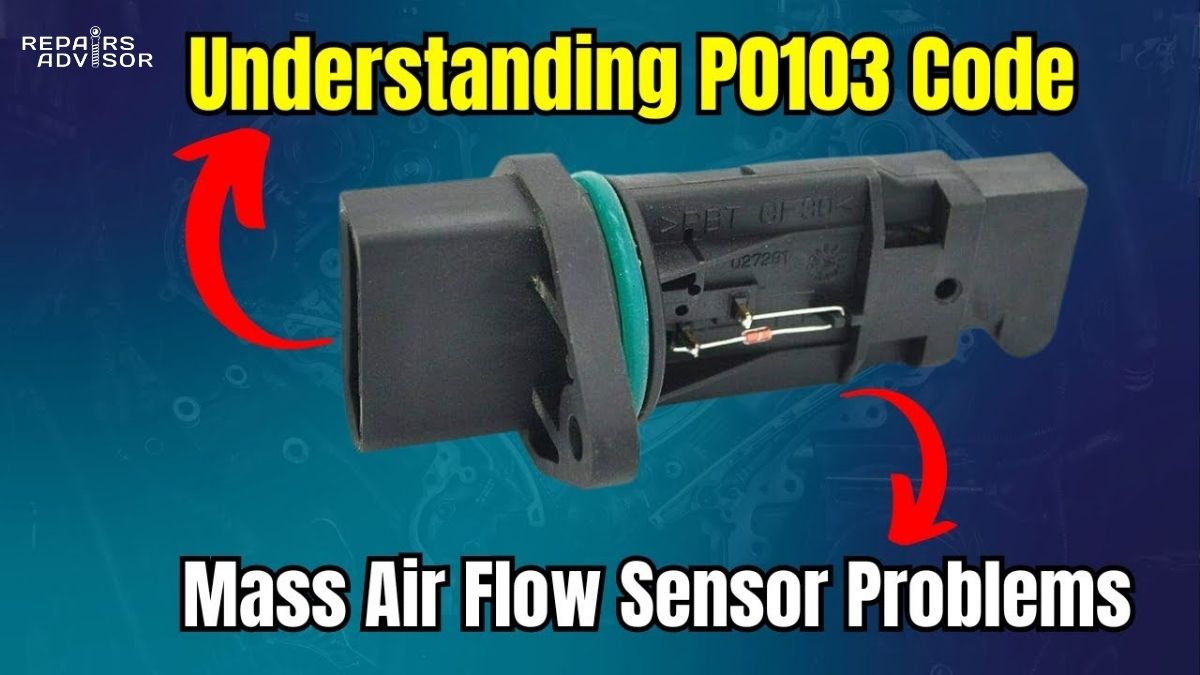
A check engine light paired with rough idle, hesitation on acceleration, or a whiff of unburned fuel from the tailpipe often traces back to one small sensor sitting just after the air filter box. P0103 — Mass or Volume Air Flow “A” Circuit High Input — means the powertrain control module (PCM) is reading a mass air flow sensor voltage signal pegged above the range it expects for current engine speed and load. The code says nothing about how much air is actually entering the engine; it’s a statement about the electrical signal itself.
Quick Answer
P0103 sets when the PCM detects a MAF signal voltage above its calibrated ceiling — usually from a short to a reference or power circuit, a corroded connector, or a sensor element fouled or burned out internally, rather than from an actual airflow problem. MAF sensor cleaner resolves contamination-related cases for under $15; if the signal stays fixed high afterward, sensor replacement runs $150–$400 in parts and labor. Left unaddressed, the false-high reading over-fuels the engine and accelerates catalytic converter wear.
What Does P0103 Mean?
Most gasoline engines built since the mid-1990s use a hot-wire or hot-film MAF sensor mounted in the intake tract between the air filter and the throttle body. The element heats to a fixed temperature, and incoming air cools it proportionally to how much mass is flowing past — the sensor converts that cooling effect into a voltage or frequency signal, which the engine management system translates into grams-per-second of airflow to calculate injector pulse width.
P0103 triggers when that voltage sits near the top of its expected range — often close to the 5V reference ceiling — in a way that doesn’t match what the throttle position sensor and engine speed suggest should be happening. Think of it like a fuel gauge that suddenly reads full the instant you start the engine, before you’ve added a drop: the PCM has no reason to distrust the gauge, so it acts on the number it’s given and over-fuels accordingly. P0103 is the mirror image of P0102 (MAF circuit low input) — same circuit, opposite failure direction. Unlike bank-specific codes, P0103 isn’t tied to a cylinder bank, since most production vehicles run a single MAF sensor ahead of the throttle body.
Symptoms of a P0103 Code
A high-input MAF signal tells the PCM more air is arriving than actually is, so the engine ends up running artificially rich. Watch for:
- Rough or unstable idle → the PCM is adding fuel based on a phantom airflow reading, unbalancing the idle mixture
- Hesitation or stumbling on acceleration → fuel trim calculations lag the sensor’s erratic signal
- Black smoke from the tailpipe → classic sign of a rich-running condition from over-fueling
- Hard starting, especially cold → excess fuel floods the cylinders before combustion stabilizes
- Noticeably reduced fuel economy → the engine is burning more fuel than the load actually requires
- Check engine light, sometimes accompanied by related misfire codes if the rich condition is severe enough to foul spark plugs
These symptoms tend to show up together rather than in isolation, because they all stem from the same root cause: the PCM trusting a bad number. Short-term fuel trim reacts first, pulling fuel back in real time as the oxygen sensors report a rich exhaust mixture. If the MAF signal stays pegged high, long-term fuel trim eventually adapts too — at which point the rough idle and hesitation can partially mask themselves until the trims max out and the engine can no longer compensate.
Common Causes of P0103
Because P0103 is a circuit code rather than a performance code, the fault usually lives in the wiring or the sensor itself, not in the intake tract:
- Chafed or shorted wiring — the signal wire rubbing against the 5V reference or power circuit will pull the signal artificially high
- Corroded or water-intruded connector — common on vehicles that see road spray or engine bay pressure washing
- Contaminated sensor element — oil migrating from an aftermarket oiled air filter (see how air filters are meant to trap debris before it reaches the sensor) can coat the hot-wire element and distort its reading
- Internal sensor failure — a burned-out or degraded hot-wire/hot-film element can peg the output high regardless of actual airflow
- PCM fault — rare, but a damaged driver circuit inside the module itself can misinterpret a normal signal
Note what’s usually not the cause: unlike P0171 or P0174 (System Too Lean), which typically point to vacuum leaks or unmetered air downstream of the MAF, P0103 is an electrical signal fault. Chasing intake leaks first, when the real problem is a shorted wire, wastes diagnostic time.
How to Diagnose P0103
Confirm the fault before replacing parts:
- Pull the code and freeze frame data, then check live MAF grams-per-second at idle against a known-good reference for your engine displacement — most four-cylinder engines idle in a roughly 3–7 g/s range, though exact figures vary by manufacturer calibration
- Watch the live MAF voltage or g/s reading while wiggling the harness near the sensor connector and along its routing — a signal that spikes with movement points to chafed wiring
- Inspect the connector pins for corrosion or moisture intrusion
- Remove the sensor and visually check the hot-wire or hot-film element for an oily film or visible debris
- Back-probe the signal wire with a multimeter at key-on, engine-off and again at idle, confirming the voltage doesn’t exceed the sensor’s rated maximum (commonly 4.5–5V)
- Unplug the MAF connector and observe whether the code clears and symptoms improve — most PCMs fall back to a fixed speed-density fueling table with the sensor disconnected, which helps isolate a sensor or wiring fault from a PCM-side issue
A basic OBD-II scanner covers steps 1 and 6; see the OBD code reading guide for how to pull live data and freeze frames. The freeze frame is worth reading closely — it captures engine speed, load, and coolant temperature the instant the code set, which tells you whether the fault appeared at idle, under load, or only when the engine was cold, and narrows the wiring inspection to the conditions that actually trigger it. A digital multimeter with a min/max recording function is the other key tool here, since a wiring short can spike briefly and reset before a simple voltage check would catch it.
How to Fix P0103
Work through these options in order of cost, starting with the cheapest and most common fix:
| Fix | Cost | Time | Skill Level | Best For |
|---|---|---|---|---|
| MAF sensor cleaning | $10–$15 (cleaner only) | 20–30 minutes | Novice DIY | Contamination from oiled filters or road debris |
| MAF sensor replacement | $150–$400 parts + labor | 30–60 minutes | Novice–intermediate DIY | Signal stays fixed high after cleaning, or element tests bad |
| Wiring/connector repair | $100–$300 | 1–2 hours | Professional recommended | Signal moves with harness wiggle test or connector shows corrosion |
Dedicated MAF sensor cleaner — not general electronics cleaner or brake cleaner, which can leave a residue or damage the delicate wire element — dissolves oil film without disturbing the sensor’s calibration and resolves a large share of contamination-related P0103 cases. If the voltage stays pegged high after cleaning and drying fully, the sensor itself has failed and replacement is the next step; most MAF sensors are a single connector and two screws, well within reach of an intermediate DIYer. Wiring and connector repairs on the sensor circuit call for proper crimping, soldering, and heat-shrink technique to avoid introducing a new intermittent fault — if you don’t have that equipment on hand, a professional repair is the more reliable route.
Is It Safe to Drive with a P0103 Code?
P0103 isn’t an immediate do-not-drive situation the way a brake or steering code would be, but it isn’t one to ignore for weeks either. A sustained rich condition forces the oxygen sensors to compensate through fuel trim, and once that compensation maxes out, unburned fuel starts washing down cylinder walls and fouling spark plugs — which can cascade into a random misfire code. Extended rich running also loads the catalytic converter with more unburned fuel than it’s designed to process, and repeated overheating is one of the more common paths to a P0420 catalyst efficiency code — a considerably more expensive repair than the MAF sensor that caused it. Plan to diagnose and repair within a few days rather than letting it ride through a long road trip.
Related MAF Circuit Codes
P0103 belongs to a small family of MAF circuit codes that share the same sensor and wiring but fail in different directions: P0100 (general circuit malfunction), P0101 (range/performance), P0102 (circuit low input — the opposite fault from P0103), and P0104 (intermittent signal). If a scan turns up more than one of these alongside P0103, focus the diagnosis on the shared wiring harness and connector rather than treating each code as a separate problem.
Some manufacturers combine the mass air flow element and intake air temperature (IAT) sensor in a single housing, sharing a connector but running on separate circuits internally. On these combined units, an IAT-related code appearing alongside P0103 usually still points to the connector or shared ground rather than two unrelated sensor failures — worth checking before condemning both sensors separately.
Frequently Asked Questions
What exactly does P0103 mean, and why does it happen?
P0103 means the powertrain control module is reading a voltage signal from the mass air flow sensor that sits above the range it expects for current engine speed and load. It’s a statement about the electrical signal, not a measurement of how much air is actually entering the engine — the two most common reasons are a wiring fault that pulls the signal high, or a sensor element that’s contaminated or has failed internally.
Should I stop driving right away if I get this code?
No — P0103 isn’t a do-not-drive situation like a brake or steering code. It does put the engine into a sustained rich condition, though, and driving on it for weeks can lead to a much more expensive catalytic converter code. Plan to diagnose it within a few days rather than letting it ride indefinitely.
Is this a repair I can do myself?
Cleaning or swapping the MAF sensor is well within reach of an intermediate DIYer — it’s typically one connector and two screws. Chasing the fault back into the wiring harness is a different job: it calls for proper crimping and soldering technique, and a professional repair is the more reliable route if you don’t have that equipment.
What tools and parts do I need?
A basic OBD-II scanner to pull the code and freeze frame data, dedicated MAF sensor cleaner (never general electronics or brake cleaner), and a multimeter if you suspect wiring. A replacement sensor only enters the picture if cleaning doesn’t clear the high reading.
How long does the repair actually take?
Cleaning the sensor is a 20–30 minute job. Swapping it outright runs 30–60 minutes for most vehicles. A wiring or connector repair is the longest at 1–2 hours, mostly spent tracing the fault rather than fixing it.
What’s the most common mistake people make with this code?
Treating it like a vacuum leak. P0171 and P0174 (System Too Lean) are the codes that usually point to unmetered air getting past the sensor — P0103 is an electrical circuit fault. Spending an afternoon smoke-testing the intake when the real problem is a chafed wire is the single biggest time-waster on this code.
Will MAF cleaner alone fix it, or do I need a new sensor?
It depends on the cause. If the code traces to oil migrating off an aftermarket oiled air filter and coating the sensor element, cleaning it resolves a large share of cases for under $15. If the voltage stays pegged high after a full cleaning and drying cycle, the element itself has failed and only replacement will clear it.
P
Any diagnostic shortcuts to confirm P0103 quickly?
Unplug the MAF connector — most PCMs drop into a fixed speed-density fueling table with the sensor disconnected, which immediately separates a sensor/wiring fault from a PCM-side issue if the code clears. A multimeter with min/max recording catches wiring shorts that spike briefly and reset before a static voltage check would ever see them.
Does the diagnostic approach change across vehicle makes?
Mostly not — the circuit logic is generic across OBD-II vehicles. The one wrinkle: some manufacturers house the MAF element and the intake air temperature sensor in a single connector on separate circuits. An IAT-related code appearing alongside P0103 on these combined units usually still traces back to the shared connector or ground, not two independent sensor failures.
What happens if I ignore a P0103 code, and how do I keep it from coming back?
Sustained rich running washes unburned fuel down the cylinder walls, which can foul spark plugs and load the catalytic converter well beyond what it’s designed to process. To keep it from recurring, avoid oiled aftermarket air filters near the sensor, and make sure any wiring repair is properly sealed against moisture — corrosion is the most common repeat offender on this circuit.