

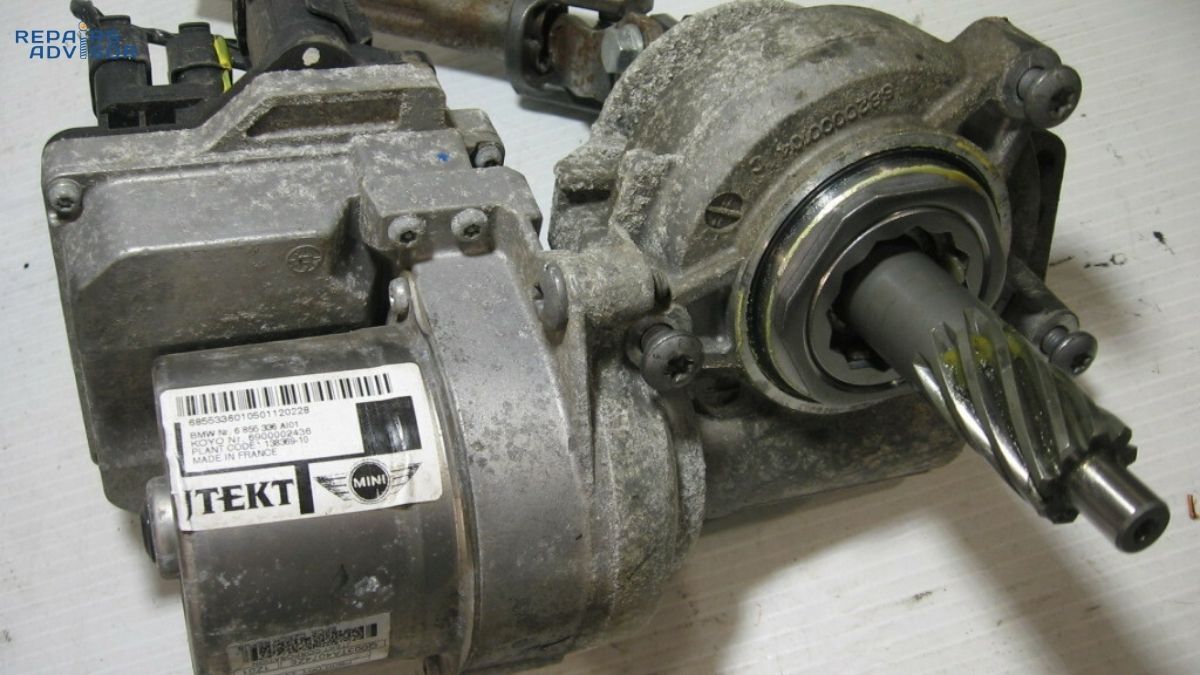
Electric power steering does away with the belt-driven pump and pressurized fluid lines that hydraulic systems rely on, replacing them with an electric motor and a controller smart enough to decide exactly how much help the driver needs at any given moment. That combination — motor plus controller — is doing more real-time calculation than most drivers realize every time they turn the wheel.
Quick Answer
The EPS motor and controller work together to add electric assist torque to the driver’s steering input — a torque sensor reports how hard the driver is turning the wheel, and the controller (EPS-ECU) calculates the right amount of motor assist based on that input plus vehicle speed, then commands the motor in real time. A failing motor or controller triggers an EPS warning light and a sudden, significant increase in steering effort, most dangerous at low speed — motor or module replacement commonly runs $300–$1,000, while a diagnostic scan alone is often just $60–$150.
What Does the EPS Motor and Controller Do?
An EPS system is really two components working as one: a motor that physically adds torque to the steering system, and a controller that decides how much torque to add and precisely when. Neither piece does anything useful without the other — the motor has no way to know what the driver needs without the controller’s instructions, and the controller’s calculations mean nothing without a motor to execute them. This pairing is what makes electronic power steering fundamentally different from older hydraulic systems: instead of a mechanical pump providing constant assist pressure, an EPS system calculates and delivers exactly the assist needed, moment to moment.
Where the EPS Motor Is Mounted — Three Design Approaches
Manufacturers place the EPS motor in different spots along the steering system, and where it sits changes how the steering feels and how the system performs at different speeds.
Column-Assist (C-EPS)
Column-assist systems mount the motor, controller, and torque sensor together on the steering column itself, close to the driver. That compact packaging reduces the torque the motor needs to generate, making it a natural fit for smaller vehicles. The trade-off is steering feel: C-EPS tends to feel light and is well suited to urban driving and parking, but can feel less responsive than assist systems mounted closer to the wheels.
Rack-Assist (R-EPS)
Rack-assist systems put the motor directly on the steering rack, delivering assist through the rack-and-pinion gear itself rather than further up the column. This placement gives better precision and more confident control at higher speeds, adapts more effectively to changing road conditions, and runs more efficiently than column-assist designs — often at the cost of a larger, more expensive motor assembly.
Pinion-Assist (P-EPS)
Pinion-assist systems land between the other two, mounting the motor on the pinion shaft rather than the column or the rack itself.
| Design | Motor Location | Steering Feel | Best Suited For |
|---|---|---|---|
| Column-Assist (C-EPS) | Steering column | Light, less responsive | Smaller vehicles, urban/parking driving |
| Pinion-Assist (P-EPS) | Pinion shaft | Balanced | Mid-size vehicles |
| Rack-Assist (R-EPS) | Steering rack | Precise, more responsive | Higher-speed handling, variable feel |
How the Controller Decides How Much Assist to Apply
The Torque Sensor — Reading Driver Effort
Everything starts with the torque sensor, which measures exactly how much force the driver is applying to the steering wheel and reports that value to the EPS controller. This sensor input works alongside data from the steering angle sensor, which tells the controller not just how hard the driver is turning, but how far the wheel has rotated.
Speed-Sensitive Assist — More at Parking Speed, Less at Highway Speed
The controller doesn’t apply a fixed amount of assist for a given torque input — it adjusts based on vehicle speed. At low speeds, during parking or tight maneuvering, the system provides significantly more assist to keep steering effort light. At highway speeds, assist drops off deliberately, trading light effort for better road feel and directional stability. This speed-sensitive behavior is the single biggest difference in how EPS feels compared to older fixed-assist hydraulic systems.
The Assist Calibration Map and Real-Time Motor Current Control
Behind the scenes, the controller references a calibration map that defines the relationship between steering torque, vehicle speed, and the target assist torque the motor should produce. Running on the same class of hardware described in how ECUs work, the controller continuously calculates target assist from that map and commands precise motor current to match it in real time. Additional context — like yaw rate from other vehicle systems — often arrives over the vehicle’s communication network, letting the EPS controller factor in broader driving conditions beyond just torque and speed.
How This Compares to Hydraulic Power Steering
The biggest practical difference between EPS and hydraulic power steering is that a hydraulic pump runs continuously, driven off the engine whether assist is needed or not, while an EPS motor only draws power when the controller commands assist. That’s a meaningful efficiency gain at highway cruising speed, where a car traveling in a straight line needs essentially no steering assist at all. The broader control architecture behind this — sensor fusion, calibration, and fault handling across the whole EPS control system — is what makes this on-demand approach possible in the first place.
Signs of EPS Motor or Controller Failure
The EPS Warning Light and Failsafe Mode
An illuminated EPS warning light — typically a steering wheel icon on the dash — means the controller has detected a fault and dropped the system into a failsafe mode, disabling power assist rather than risking an unpredictable or incorrect assist output.
Sudden Increase in Steering Effort
The most immediately noticeable symptom of an EPS fault is a sharp, sudden increase in how much physical effort it takes to turn the wheel. This is most pronounced at low speed — exactly the situation where the system normally provides the most assist, so its absence is felt hardest during parking and tight maneuvering.
Grinding Noise, Burning Smell, or Erratic Assist
Grinding noises near the column or rack, a burning smell, or assist that feels inconsistent or unpredictable point toward a motor-level problem — worn brushes in a brushed motor, overheating, or an internal short circuit are commonly cited causes. Any of these symptoms can also point toward wear further down the steering chain, so it’s worth ruling out rack-and-pinion geometry issues alongside an electrical diagnosis.
Safety note: A sudden loss of EPS assist is a genuine driveability hazard, most dangerous at low speed and during parking maneuvers where the effort increase is felt hardest. This isn’t a hypothetical risk — documented recalls from Tesla, Hyundai, and RAM have all involved sudden or intermittent loss of power steering assist tied to increased crash risk. If the EPS warning light comes on or steering effort suddenly increases, pull over safely and have the vehicle inspected before continuing to drive.
Diagnosis and Repair Costs
Diagnostic Scan First
A diagnostic scan is a relatively inexpensive first step, typically $60–$150, and it’s worth doing before assuming the worst. A qualified technician using OEM-level tools can often isolate an EPS fault to something as simple as a blown fuse, a damaged wiring harness, or a failing sensor — not every EPS complaint means the motor or the whole rack has failed.
Motor/Control Module vs. Full Rack Replacement
If the fault does trace back to the motor or control module itself, replacement commonly runs $300–$1,000, sometimes reaching $1,200 or more once labor is included. A full electric steering rack replacement is a bigger job — $1,200–$2,000 for standard systems, and $1,800–$3,000 or more on luxury or EV platforms where the rack assembly is more complex.
Skill-level disclaimer: EPS diagnosis requires OEM-level scan tools to read controller fault codes accurately, and many repairs — whether motor, module, or full rack — require post-repair calibration or programming to function correctly. This is a professional-tier repair; readers without electronic steering system experience should have this diagnosed and repaired at a qualified shop rather than attempting it independently.
Maintaining Your EPS System
The single best thing a driver can do for an EPS system is treat the warning light seriously the first time it appears rather than continuing to drive on reduced or absent assist. It’s also worth remembering that mechanical wear elsewhere in the steering chain — worn tie rods, ball joints, or column components — can produce symptoms that mimic or compound an EPS electrical fault, which is exactly why a proper diagnostic scan matters before assuming the problem is purely electronic.
For a broader look at how EPS fits into the rest of the steering and control systems, the vehicle systems library covers the surrounding components in more depth. EPS motor and controller specifications vary by platform — Ford manuals cover EPS system details for their EPS-equipped model lineup.
EPS Motor + Controller: Frequently Asked Questions
Following the Outline Creation research protocol — reusing the research and 12 verified URLs already extracted for “EPS motor controller” earlier in this session (no repeat web search or URL extraction needed).
What do the EPS motor and controller do?
They work as a pair: the motor physically adds torque to the steering system, and the controller (EPS-ECU) decides exactly how much torque to add and when, based on driver input and driving conditions. This on-demand calculation is what makes electronic power steering fundamentally different from older hydraulic systems that provide constant assist pressure regardless of need.
What are the different EPS motor placement types?
Column-assist (C-EPS) mounts the motor, controller, and torque sensor on the steering column itself — compact and well suited to smaller vehicles, though the steering feel is lighter and less responsive. Rack-assist (R-EPS) puts the motor directly on the steering rack, giving better precision and control at higher speeds. Pinion-assist (P-EPS) mounts the motor on the pinion shaft, landing between the other two in feel and performance.
How does the controller decide how much assist to apply?
A torque sensor measures how hard the driver is turning the wheel, working alongside the steering angle sensor to report both effort and rotation. The controller combines that with vehicle speed — more assist at parking speed, less at highway speed — using a calibration map to calculate target assist torque, then commands precise motor current in real time. Additional data, like yaw rate, often arrives from other systems over the vehicle’s communication network.
How is EPS different from hydraulic power steering?
The core difference is that a hydraulic pump runs continuously off the engine whether assist is needed or not, while an EPS motor only draws power when the controller commands it. That makes EPS more efficient, particularly at highway speed where a car traveling straight needs little to no steering assist.
What are the signs of EPS motor or controller failure?
The clearest sign is an illuminated EPS warning light — typically a steering wheel icon — which means the controller has detected a fault and disabled assist as a failsafe. That produces a sudden, sharp increase in steering effort, felt most strongly at low speed and during parking. Grinding noise, a burning smell, or inconsistent assist point toward a motor-level problem such as worn brushes, overheating, or an internal short circuit.
Is it safe to keep driving if the EPS warning light comes on?
No — treat it as a genuine driveability hazard, not a minor dashboard notification. Sudden loss of EPS assist is most dangerous at low speed and during parking, exactly when the system normally provides the most help. This isn’t hypothetical: documented recalls from Tesla, Hyundai, and RAM have all involved sudden or intermittent loss of power steering assist tied to increased crash risk. If the light comes on or steering effort suddenly increases, pull over safely and have the vehicle inspected.
How much does EPS motor/controller repair cost?
A diagnostic scan is a relatively inexpensive first step at $60–$150, and it’s worth doing before assuming the worst — many EPS faults trace back to something as simple as a blown fuse or a failing sensor. If the motor or control module itself needs replacing, that commonly runs $300–$1,000 (sometimes $1,200+ with labor). A full electric steering rack replacement is a bigger job: $1,200–$2,000 for standard systems, $1,800–$3,000+ on luxury or EV platforms.
Do I need special tools to diagnose an EPS fault?
Yes — EPS diagnosis requires OEM-level scan tools to accurately read controller fault codes, and many repairs (motor, module, or full rack) need post-repair calibration or programming to function correctly afterward. This is a professional-tier repair; readers without electronic steering system experience should have it diagnosed and repaired at a qualified shop.
Can worn steering linkage components mimic an EPS fault?
Yes. Mechanical wear in tie rods, ball joints, or column components, or issues in the broader rack-and-pinion geometry, can produce symptoms — noise, unusual steering feel — that overlap with an EPS electrical fault. That overlap is exactly why a proper diagnostic scan matters before assuming the problem is purely electronic.