A power window that grinds, drops on its own, or stops responding almost always points back to the window regulator — and the first question most drivers have isn’t how it works, but what it’s going to cost to fix. Between OEM and aftermarket parts, independent shops and dealerships, and the DIY option, the price for the same repair can swing by several hundred dollars depending on which path you take.
Quick Answer: Window regulator parts run $40–$300+ depending on OEM vs. aftermarket and vehicle make. Professional replacement typically totals $150–$800 including labor, with independent shops usually landing around $250–$500 and dealerships higher. DIY replacement can save $100–$300 in labor for those comfortable working around door wiring and unsupported glass — though vehicles with side-impact airbags mounted in the door are a case for professional service.
What Determines Window Regulator Replacement Cost
Three variables drive the price more than anything else: the part itself, labor time, and how the regulator is mounted.
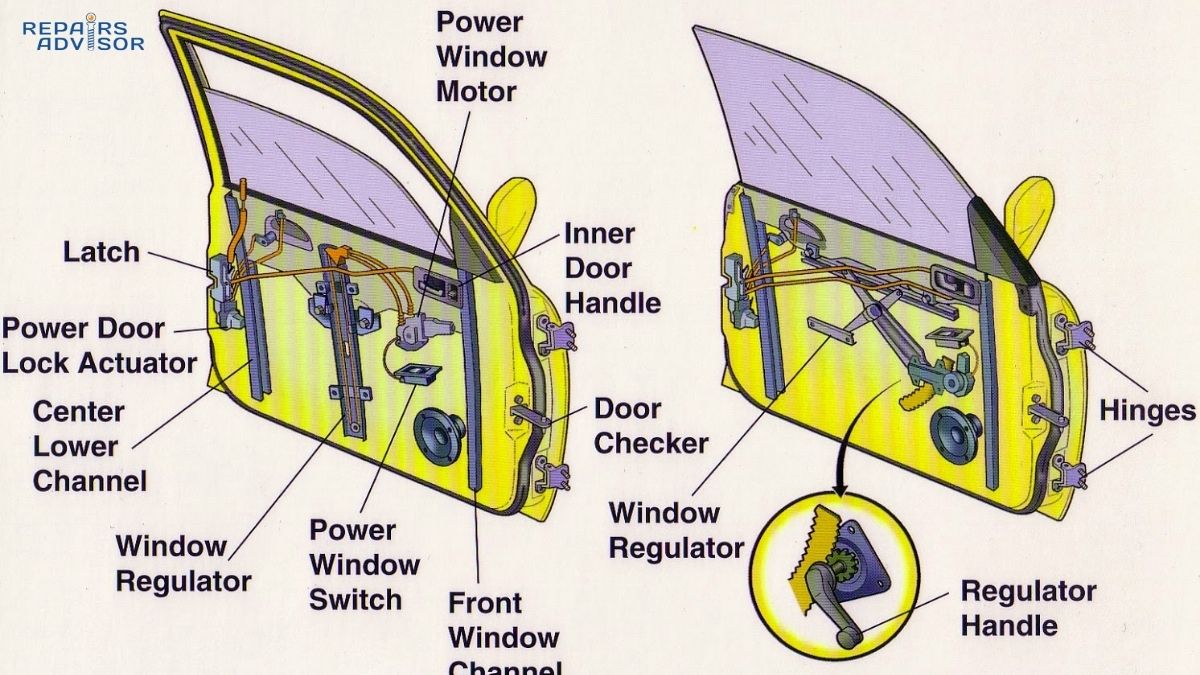
Parts range from $40–$300+. Aftermarket regulators sit at the low end and are usually adequate for older or high-mileage vehicles; OEM parts run $50–$200 more but tend to fit tighter and last longer, which matters since cable-tension issues are the most common cause of repeat failure. For the mechanics of why tension matters so much, see how the door window regulator works.
Labor varies by shop type: independent shops typically bill $80–$150/hour, while dealerships run $150–$300/hour. Most regulator jobs take 1 to 3 hours depending on door design and whether the window motor is integrated into the regulator assembly or replaced separately — integrated units cost more but eliminate a second point of failure.
Mounting style adds a wildcard on older vehicles. Some regulators are riveted rather than bolted to the door, which means a technician has to drill out each rivet and install replacement hardware. That adds roughly $30–$160 in combined parts and labor on top of the base job — worth asking about when you get a quote, since it’s easy for a shop to underestimate on the phone.
Regulator or Motor? Confirming What You’re Actually Paying For
Before paying for a regulator, it’s worth ten seconds of listening to make sure that’s actually the failed part. Roll the window switch and listen at the door: a motor that hums or whines but produces no glass movement usually means the regulator’s cable or gears have failed while the motor itself is fine. Total silence from the door — no hum at all — points toward the window motor or, more often, the electrical path feeding it.
That electrical path is the cheapest thing to rule out and the easiest to overlook. A blown fuse or a failed relay produces the exact same symptom as a dead motor — no response at all — for a fraction of the cost. Check the fuse box for the window circuit before ordering a regulator; a quick primer on how automotive fuses and relays fail makes the check straightforward even without a multimeter. Paying for a $200–$500 regulator swap when a $15 fuse was the real problem is the single most avoidable cost in this repair.
DIY Replacement: Cost Savings and What It Requires
Doing the job yourself typically saves $100–$300 in labor, with parts-only cost for an aftermarket regulator running $55–$200. That savings is real, but it comes with genuine requirements, not just patience.
Door panels are held on with plastic clips that break easily on removal, and the regulator’s lift cable has to be re-spooled to exact tension during reassembly — too loose and it binds or jumps the pulley, too tight and it strains the motor. This is also why regulators are sold as complete assemblies rather than individual parts; getting cable tension right on a bare mechanism is failure-prone enough that manufacturers don’t sell it any other way.
Safety comes first on this job, and it isn’t optional. Before disconnecting the old regulator, raise the window fully and support the glass with tape or a wood block wedged in the frame — an unsupported pane can slide down and shatter the moment the regulator releases it. If your vehicle has side-impact airbags mounted in the door — common on many models built in the last two decades — disconnect the negative battery terminal and wait at least 30 minutes before opening the door panel; see how a car battery works for what that wait actually accomplishes. Never probe, pull, or unplug yellow-coded connectors, which mark the SRS/airbag circuit — side airbag deployment control circuit issues illustrate why that circuit is treated differently from the rest of the door’s wiring harness. If you’re not confident identifying those connectors on sight, this is a job for a professional rather than a place to guess.
Professional Replacement Cost by Scenario
Where you take the car changes both the price and what you’re paying for:
| Option | Typical Cost | Parts Quality | Best For |
|---|---|---|---|
| DIY | $55–$200 (parts only) | Your choice, usually aftermarket | Comfortable with door disassembly and no door-mounted airbags |
| Independent Shop | $250–$500 | Quality aftermarket | Most drivers — balances cost and turnaround |
| Dealership | $400–$800 | OEM | Vehicles under warranty or needing exact OEM fit |
The OEM-vs-aftermarket decision matters more here than on many repairs, because a marginal aftermarket regulator that fails again means paying labor twice. OEM parts cost $50–$200 more upfront but reduce that risk; quality aftermarket brands split the difference and can save $50–$150 without the reliability gap of the cheapest options. If your vehicle uses a broader electrical system shared between the window circuit and other body electronics, mention that to the shop — it can affect diagnostic time if the symptom turns out to be electrical rather than mechanical.
Riveted-door vehicles should expect a quote at the higher end of these ranges, since the extra drill-out labor isn’t always itemized separately until the technician has the door panel off.
Repair the Regulator, or Replace the Whole Assembly?
In practice, “repair” isn’t really on the table for most window regulators — they’re sold and installed as a complete cable-and-motor assembly because re-tensioning a bare mechanism correctly is difficult enough that manufacturers design around replacing the whole unit rather than servicing it in place.
The real decision is which assembly to buy. For a vehicle you plan to keep for years, OEM or a well-reviewed aftermarket brand is worth the extra cost — a second failure means paying for the labor-intensive door teardown all over again. For an older vehicle nearing the end of its service life, the cheapest functional aftermarket option is a reasonable call, since the goal is getting the window working reliably for its remaining time on the road rather than maximizing long-term durability.
FAQs
Why does replacing a window regulator cost so much for what seems like a small part?
Most of the cost is labor, not the part. The regulator sits inside the door, so a technician has to remove the interior door panel and vapor barrier to reach it — often 1–3 hours of work regardless of the part’s price. Regulators are also sold as complete cable-and-motor assemblies rather than individual pieces, because re-tensioning the lift cable correctly on a bare mechanism is difficult enough that manufacturers design around replacing the whole unit.
Can I keep using the vehicle while I decide what to do?
If the window is stuck in the closed position, yes — drive normally and get quotes on your own timeline. If it’s stuck open, or dropped into the door, that’s a security and weather exposure issue worth addressing sooner: a piece of clear tape or plastic sheeting over the opening is a reasonable short-term stopgap while you schedule the repair.
How much does window regulator replacement typically cost?
Parts alone run $40–$300+ depending on OEM vs. aftermarket. A full professional job — parts and labor — typically lands at $250–$500 at an independent shop or $400–$800 at a dealership. DIY brings the cost down to parts only, roughly $55–$200.
Is it the regulator or the motor that’s actually broken?
Listen at the door while operating the switch. A motor that hums or whines with no glass movement points to the regulator’s cable or gears; total silence usually means the motor or its electrical supply. Confirming this before ordering parts avoids paying for a regulator swap when the real problem was electrical.
Should I buy OEM or aftermarket?
OEM parts cost $50–$200 more but generally fit tighter and hold cable tension longer — worthwhile on a vehicle you plan to keep for years, since a second failure means paying for the door teardown labor twice. Quality aftermarket brands split the difference, saving $50–$150 without the reliability gap of the cheapest bargain options, and are a reasonable call on an older vehicle nearing the end of its service life.
How much can I save doing it myself?
Typically $100–$300 in labor, since you’re only paying for the part. The tradeoff is time — most first-time DIYers should plan for the higher end of the 1–3 hour range professionals bill, plus extra care around fragile door-panel clips.
What tools and skills does a DIY window regulator job actually require?
Basic hand tools cover most of it — trim removal tools for the door panel clips, a socket set, and patience. The harder part is judgment: knowing how much force a clip can take before it snaps, and re-spooling the lift cable to the correct tension on reassembly if you’re working with a bare mechanism rather than a pre-tensioned replacement assembly.
Why can’t I just replace the broken cable or gear inside the regulator instead of the whole assembly?
You technically can source individual cables or gears for some regulator designs, but most shops and manufacturers don’t recommend it. Getting cable tension exactly right on a used mechanism is failure-prone, and a mis-tensioned repair often fails again within months — at which point you’ve paid for the labor twice. Replacing the complete assembly is the standard approach precisely because it sidesteps that risk.
Does it cost more if my window regulator is riveted instead of bolted?
Yes — expect roughly $30–$160 more in combined parts and labor. Older vehicles often rivet the regulator to the door rather than bolt it, so a technician has to drill out each rivet and install replacement hardware. It’s worth asking a shop directly whether your vehicle is riveted, since that detail isn’t always reflected in a phone quote.