

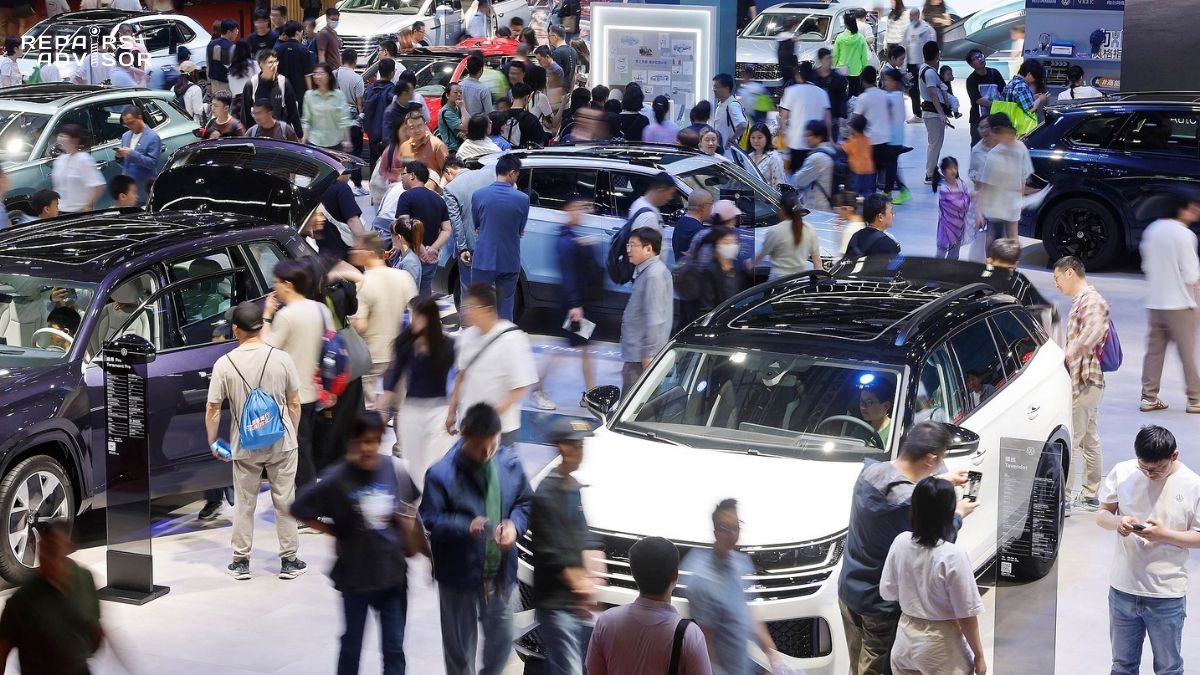
If the U.S. auto story in 2026 is “hybrids quietly rising,” China’s story is almost the opposite: electric and plug-in vehicles have already won the war for market share — but the broader market is now shrinking, cooling, and maturing all at once. Here’s what’s really going on in the world’s largest car market.
The Big Picture: Pressure, Not Collapse
China’s domestic auto market has pulled back meaningfully in 2026. Total vehicle shipments are down 4.1% for the first half of the year, while domestic sales specifically fell 20.8% (Automobility). That’s a sharp deceleration from the subsidy-fueled boom of late 2025, and analysts describe it less as a collapse than a shift into a more mature, demand-constrained phase — one where affordability, replacement cycles, and product mix now matter more than raw volume growth.
Passenger vehicle retail sales for the first half totaled 8.701 million units, down 20.2% year-on-year, as the market searched for a bottom after retreating from unusually elevated 2025 levels (CnEVPost).
NEVs Have Crossed a Structural Threshold
Even with the slowdown, electrification keeps advancing. New energy vehicles — a category covering battery-electric, plug-in hybrid, and fuel-cell models — reached 49.6% of total first-half shipments, climbing to 58.4% in June alone, and accounting for roughly 63% of passenger vehicle sales.
By mid-July, NEV retail penetration pushed even higher, hitting 63% during July 1–19, with wholesale penetration reaching 68.1%. The CPCA’s own forecast expects NEVs to represent about 64.5% of the entire July market — a record high, up from 62.9% in June.
The flip side of that story is what’s happening to gasoline cars. Retail sales of internal-combustion vehicles plunged 38.9% year-on-year in June, and production of pure gasoline light vehicles fell 56% year-on-year in early July, as high fuel prices accelerate a structural reshaping of the market.
Even NEVs Are Feeling the Slowdown
Here’s the twist: NEV sales themselves are no longer immune to the broader pullback. Passenger NEV retail sales fell 4% year-on-year during the first three weeks of July, reaching 485,000 units — still outperforming the overall market, but a clear sign that even the electrified segment isn’t growing unchecked anymore.
Much of this softness traces back to automakers pulling sales forward into June to hit their first-half targets, compounded by an unusually high sales base from a year earlier. Add in the World Cup, intense summer heat keeping shoppers out of showrooms, and a generally cautious, wait-and-see mood among consumers, and July is shaping up as a seasonally slow month across the board.
Inventory pressure is adding to the strain. At the end of June, China’s passenger car industry inventory stood at 3.43 million units, and elevated stock levels are squeezing dealer cash flow, pushing many brands to deliberately curb production rather than keep restocking.
Exports Are Picking Up the Slack
While the domestic market cools, exports have become China’s key volume stabilizer. Overseas shipments rose 65.3% to 5.1 million units in the first half, accounting for nearly 37% of June’s total shipments. Industry watchers increasingly frame this as a structural pivot — China moving from a purely domestic growth story to a global production platform, using international demand to absorb capacity that the home market can no longer fully sustain.
Domestic Brands Are Pulling Further Ahead
The competitive landscape inside China continues to tilt sharply toward homegrown players. Chinese brands now control 72% of passenger vehicle shipments, while German and Japanese brands have declined 29.0% and 17.7% respectively. The market is effectively splitting into two ecosystems: domestic brands dominating the NEV space, and foreign automakers increasingly concentrated in the shrinking ICE segment.
On the sales side, BYD continues to lead the NEV market with a 22.3% share as of June, while Tesla ranked fifth for a second consecutive month — a notable shift in the pecking order compared to a few years ago.
An Unexpected Side Effect: The Rise of Used NEVs
One quieter trend worth watching: China’s used car market is now nearly matching new car sales in volume. In the first five months of 2026, new car retail sales reached 8.148 million units, while used car transactions hit 8.095 million units — a level of parity that industry insiders say marks a genuine turning point for the secondhand market.
Much of this growth is being driven by changing attitudes toward used NEVs specifically, as buyers increasingly see secondhand electric and plug-in models as an affordable, practical option — particularly for households that already own a primary gasoline vehicle and want a cheaper second car for short commutes.
The Bottom Line
China’s auto market in 2026 is a study in contrasts: a market that’s shrinking overall, yet one where electrification has become the undisputed default rather than a growing trend. NEVs aren’t just gaining share anymore — they’re the market’s center of gravity, while gasoline vehicles are being pushed to the margins. At the same time, cooling domestic demand, rising exports, and the fast-maturing used-NEV market suggest China’s auto industry is entering a genuinely new phase — less about explosive growth, and more about how efficiently the industry can compete on intelligence, software, and global scale.